A Statue of Peace
In September 1862 a Navy commodore ordered the wreckage of two Confederate guns hauled upriver for the Sisters of the Holy Cross, to be recast as a statue of peace. The statue was never made. The record of the sisters’ war is scattered in the same way, across Navy files, travelers’ letters and newspapers that could not keep the nuns’ names straight.
On Sept. 19, 1862, Commodore Charles H. Davis, commanding the Navy’s Western Flotilla, wrote an order to First Master A.M. Grant of the steamer New National.1
“I wish you to stop at Island No. 10 and take on board the fragments of a gun known as the Lady Davis, which burst in the hands of the rebels,” it began. Grant was to stop again at Columbus, Ky., for the pieces of a second gun, the Lady Polk, “which also burst in the hands of the rebels; the fragments of this gun are lying on the bank near Mr. Davis’s house.”1
The commodore explained what the iron was for. The commanders at both places were to be told that the fragments “are to be placed at the disposal of Sister Angela, superior of the Sisters of the Holy Cross, who are the principal nurses in our military hospitals, and that they are to be recast into a statue of peace for one of the religious establishments of which Sister Angela is the superior.”1
The order is printed in the Navy’s official records of the war. It is one of the few federal records Hoosier First found, written in the war’s own months, that describe what the sisters from St. Mary’s, near South Bend, were doing.1 Their story is usually told in a sentence or two: Gov. Oliver P. Morton called, the sisters went, and they served on the Navy’s first hospital ship.2 Hoosier First went looking for what the papers of 1861 and 1862 recorded instead, and found two problems that every later account has had to work around.
The first is that the women in the stories almost never have names. The second is that the reporters often could not tell which nuns they were looking at.
Six sisters through Chicago
The first trace in the newspapers is a short item in the Chicago Tribune of Oct. 24, 1861, under the heading “Errand of Mercy.”3
“Last evening, Mother Angela and five other Sisters of the Holy Cross, from Notre Dame, near South Bend, Indiana, passed through this city on their way to Paducah, to take charge of the army hospital at that place.”3
In Indianapolis, the Indiana State Sentinel of Oct. 30 had two items about the order on the same page, and they do not agree. One reported that six of the sisters had left “yesterday for Jefferson City, Missouri, where, under the direction of the Provost Marshal of St. Louis, they will be located to relieve the wants of sick and disabled soldiers.” The other, credited to the Lafayette Courier by way of a priest, Father Kilroy, said that “six Sisters of the holy Cross will leave South Bend, by order of the Governor to join the Indiana troops at Paducah.”4
That second item is the only line Hoosier First found from 1861 that connects the sisters’ departure to the governor. The state marker that stands today puts it more strongly, calling their service a response to “Governor Morton’s call of October 1861.”2 A different account, printed 20 years later, gave the credit to someone else. A South Bend Tribune article, reprinted as a note to a poem in 1881, said that “in September, 1861, General Lew Wallace, commanding the Federal Forces in Southern Kentucky, applied to St. Mary’s, the Mother House of the Sisters of the Holy Cross, for nurses,” and that “Mother Angela, with five other Sisters, hastened to the relief of the suffering soldiers at the camp in Paducah.”5
Hoosier First could not settle which request came first, or whether both did. The two 1861 papers agree on one point: there were six sisters.3,4
When they reached Paducah, they would not have been the only nuns there. A Chicago Tribune correspondent, in a letter printed Oct. 23, reported that the government had made the courthouse a hospital “under charge of the Sisters of Mercy from Nazareth, Kentucky, who were personally engaged during our visit in bathing and attending the sick.”6 A letter in the Keokuk Daily Gate City the same day, describing the same move of the hospital from the Marine Hospital to the courthouse, said simply: “The female nurses are all Sisters of Charity.”7
“Sixteen sisters of the Holy Cross”
By the end of February 1862, the sisters were in the large general hospital at Mound City, Ill.8
A visitor from Iowa wrote a letter from there on Feb. 25 to the St. Louis Missouri Democrat. The Keokuk Gate City reprinted it on March 7.8
“At present over twelve hundred sick and wounded are here,” the letter said. “Sixteen sisters of the Holy Cross, from South Bend, Indiana, are constantly attending the wants of our wounded men. I was informed by Mother Angela that she expected eight more in a few days.” The writer said he “was gratified to hear every sick and wounded man I addressed speak in the highest terms of the untiring care and attention of these devoted Sisters.”8
A Wisconsin paper, the Manitowoc Pilot, passed on the same news and added a count of its own. “We understand that no less than thirty four Sisters of that order are now attending the several hospitals of the army in the west.”9
The Chicago Sanitary Commission, which shipped supplies down the Illinois Central to Cairo, listed what it had sent to the Mound City hospital in a report printed that March. Among 899 pairs of socks, 819 shirts and 497 sheets was one item marked for a single person: “a large sized cooking range, valued at $100 (the gift of Jewett & Root), for the use of ‘Mother Angela,’ in preparing delicacies for the sick and wounded in large quantities.”10 In early April the Tribune’s Cairo correspondent reported that a load of fruit and delicacies from Chicago had been “delivered to Mother Angela, at the hospital.”11
In none of these reports does any sister except Mother Angela appear by name.
The Navy’s letter
On June 17, 1862, Union gunboats captured Confederate batteries at St. Charles, on the White River in Arkansas. According to the Navy’s reports, a shot from a battery on the bluff penetrated the gunboat Mound City and exploded her steam drum. Many of her crew leaped overboard.1
Three days later, on June 20, Davis wrote to Secretary of the Navy Gideon Welles from the flagship Benton at Memphis. The report was printed in the Washington Evening Star on June 26 and later in the Navy’s official records.1,12
“The number of wounded men on board the hospital boat Red Rover is forty-one,” he began.12 After a long passage about the wounded commander of the Mound City, he thanked the Army doctors who had helped.12 Then he added a sentence about the sisters:
“Sister Angela, the Superior of the Sisters of the Holy Cross, (some of whom are performing their offices of mercy at the Mound City Hospital,) has kindly offered the services of the Sisters for the hospital boat of this squadron when needed. I have written to Com. Pennock to make arrangements for their coming.”12
This is the sentence the state marker’s claim rests on. Indiana’s own review of the marker text in 2013 cited this June 20 report, and the September order about the guns, as the evidence that Mother Angela offered the sisters to the Red Rover.13
The same volume shows the confusion over names. On June 23, three days after Davis’s report, Lt. Cmdr. S.L. Phelps wrote a personal letter from Memphis to Flag-Officer A.H. Foote, who had been relieved of the flotilla’s command. “The hospital boat was dispatched from here last evening to get the poor sufferers from the Mound City to more comfortable quarters,” he wrote. “The Sisters of Charity, who came down at once, advised all being sent to the Mound City Hospital, which they represent now as very perfect for its purpose.”1
Phelps did not say which community those sisters belonged to. Davis had just told the secretary that the sisters at the Mound City hospital were Sisters of the Holy Cross.1,12 Hoosier First could not determine from the records whether Phelps meant the same women.
The papers Hoosier First reviewed do not show when the sisters first went aboard the Red Rover, or how many served there. The 1881 South Bend Tribune note says Davis “asked and obtained the services of seven Sisters of the Holy Cross to take charge of the floating hospital, in which hundreds of lives were saved.”5 The National Museum of Civil War Medicine, citing the ship’s muster rolls, says four sisters appear on them, the first two coming aboard from the Mound City hospital on Christmas Eve 1862.14 Hoosier First did not see the muster rolls.
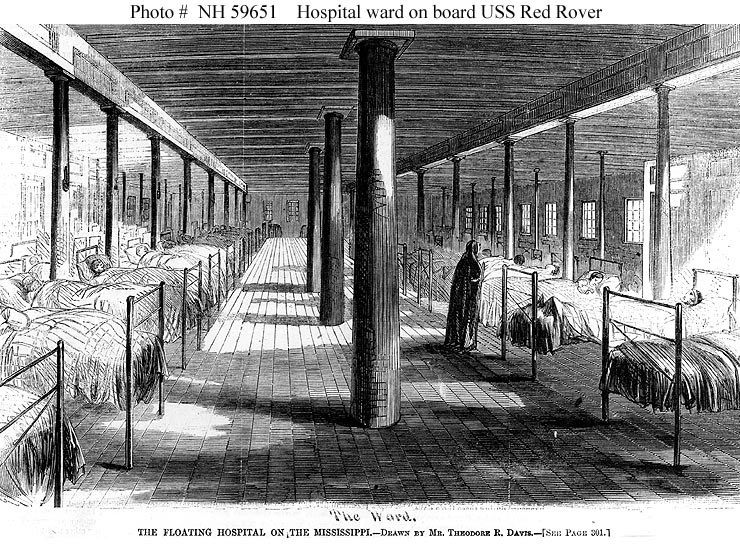
The picture with this story shows a ward of the Red Rover, engraved after a drawing by the artist Theodore R. Davis and published in Harper’s Weekly in 1863.
The guns
By September, Davis was signing as commodore. His order to First Master Grant came three months after the June report.1
The order placed the fragments of the Lady Davis at Island No. 10 and those of the Lady Polk at Columbus. Both guns, it said, had burst “in the hands of the rebels.” It directed Grant to carry the fragments “to Cairo and deliver them to the care of Captain Pennock.”1
The 1881 South Bend Tribune note said the guns reached St. Mary’s. “A memorial of those days now rests in St. Mary’s grounds, in the shape of two immense shattered cannon, captured at Island No. 10, and presented to Mother Angela by the commander of the Flotilla,” it said. “These cannon are destined to be moulded into a statue of ‘Our Lady of Peace,’ and will remain in St. Mary’s grounds as an historical monument of the dark days of our Civil War.”5 That account placed both guns at Island No. 10. The Navy’s order placed the Lady Polk at Columbus.1,5
The poet Eleanor C. Donnelly printed that note above a poem, “The Cannon in the Convent-Grounds,” in her 1881 collection Crowned with Stars. Her poem described the guns as still lying there after “nearly two decades of peace,” with green moss on “the cold metal, now rusted and rimy.”5
Hoosier First found no newspaper account of what became of the guns. A history blog about Notre Dame in the Civil War, citing letters in the congregation’s archives, says the sisters offered the guns to the government as salvage in September 1942, and that they were melted down for the war effort.15 Hoosier First could not see those letters. If that account is right, the iron the Navy set aside for a statue of peace went to war a second time, 80 years later.
“Sisters of the Holy Cross” in other places
The newspapers of the 1860s used the name “Sisters of the Holy Cross” for women in several places, and not all of them came from St. Mary’s.
In Louisiana in 1861, the same name appears in advertisements for convent schools in Plaquemine and Opelousas.16,17 Hoosier First did not determine which congregation those Louisiana sisters belonged to, and did not count them in this story.
In Washington, the Daily National Intelligencer reported in November 1862 that a new chaplain had been named for “St. Aloysius Hospital which is now under the special care of the Sisters of the Holy Cross.”18 The 1881 South Bend Tribune note listed “Washington City” among the places where sisters from St. Mary’s and its branch houses served.5
In Memphis, after the Union took the city, a Chicago Tribune correspondent wrote in March 1863 that at one hospital, “The ‘Sisters of the Holy Cross’ have charge of the patients, under the physicians.”19 In June 1866, after the war, the Memphis Public Ledger reported that the city board had thanked the Sisters of the Holy Cross for nursing the victims of the explosion of the steamer City of Memphis.20 That August, the board voted “the sum of two hundred dollars” to “each of the Sisters of the Holy Cross in attendance at the Hospital.”21 Later that month, the paper reported, “The superintendence of the small pox hospital has been given to the Sisters of the Holy Cross.”22 Hoosier First could not confirm from the Memphis papers alone that these sisters came from St. Mary’s.
The name “Mother Angela” caused its own trouble. Mother Angela of the Holy Cross, born Eliza Gillespie, was one of several women called Mother Angela who appear in the newspapers Hoosier First searched.23 Another, Ellen Hughes, a Sister of Charity and a sister of the late Archbishop Hughes, was superior of St. Vincent’s Hospital in New York and died there in September 1866.24 The New York Herald’s account of her burial said that “during the late war the deceased was active and untiring in her aid to the Sanitary Commission.”25 A reader searching old papers for “Mother Angela” and “hospital” during the war will find both women.
“Young ladies!”
Most of what the papers recorded about Mother Angela of the Holy Cross came after the war.
In January 1887 the Indianapolis Journal printed a story told by a former student at St. Mary’s Academy. On Washington’s Birthday, 1864, a band from South Bend came out to play for the pupils, and several Southern girls appeared at a window wearing small Confederate flags. “When the superior, Mother Angela, heard of the action she rushed to the girls and tore the flags from their breasts, and sent them to their rooms.” At a dance that evening, a Southern student tore down a Union flag and was struck by a classmate, Minnie Sherman. “The two words spoken by Mother Angela, ‘Young ladies!’ soon brought the girls to their senses.”26 The story was a former student’s memory, printed 23 years after the event.26
Six weeks later, on March 4, 1887, Mother Angela died at St. Mary’s. The Indianapolis Journal’s report from South Bend called her “one of the most widely-known women in this country.” It said she was a cousin of the politician James G. Blaine, and had been “educated with her cousin, now the wife of General Sherman.” Of the war, it said only: “During the war she devoted the most of her time to establishing hospitals, and overseeing the care of sick and wounded soldiers.”23 Her funeral was held at St. Mary’s on March 6, and “the interment was at St. Mary’s Academy.”27
How many
The number of sisters who served is given differently by every source Hoosier First found.
In 1861, the Indiana and Chicago papers reported six.3,4 In February 1862 the Mound City letter counted 16, with eight more expected, and the Manitowoc Pilot heard of 34 in the western hospitals.8,9 The 1881 South Bend Tribune note said “seventy-five Sisters were sent from St. Mary’s, and her branch houses,” of whom “two died from fever, caught in the discharge of their duties.”5
In 1897, Mary A. Gardner Holland published Our Army Nurses, a collection of sketches of women who had nursed in the war. It included a tribute by the Very Rev. W. Corby of Notre Dame, identified there as “three years Chaplain in the famous Irish Brigade.” Corby wrote that sixty sisters of the Holy Cross “went out under the intelligent Mother Mary Angela as superioress.”28 A sketch of Mother Angela in the same book said that some of the hospital sisters “died and were carried to their burial over the flooded Mississippi in the hospital boats,” while others “lie in the peaceful burying-ground at St. Mary’s.”28
The state marker, erected in 1963, says eighty.2
The statue that wasn’t
The sisters did not write the newspaper record of their own war. Reporters wrote it, mostly in passing, and they rarely asked any sister but Mother Angela for her name. The sketch in Our Army Nurses explained the gap. It said its author had drawn on a record compiled “from the stories of individual Sisters,” and would give instances “without the ability or permission to give names or dates.”28
What remains in the documents is a short list of facts that can be checked. Six sisters left in October 1861.3,4 Sixteen were at work at Mound City by February 1862.8 A Navy flag officer wrote to the secretary of the Navy that their superior had offered the sisters for his hospital boat.1,12 And three months later a commodore called them “the principal nurses in our military hospitals” and ordered two broken rebel guns set aside for them, to become a statue of peace.1
By 1881 the guns had lain on the grounds at St. Mary’s for “nearly two decades.”5 The statue was never cast.15
How they died
The newspaper record Hoosier First read names only a few of the Sisters of the Holy Cross who nursed in the war. It does not report how any sister other than Mother Angela died, and this story does not guess.
Mother Angela died at St. Mary’s on Friday, March 4, 1887. She was about 62.23,29 The reports did not agree on whether her death was sudden. The Indianapolis Journal’s South Bend dispatch, which ran in papers across the country, said she “died very suddenly to-day.”23 The New-York Tribune said she “had been failing for a year or two.”29 A Nebraska paper, The Frontier, said she died “at 11 o’clock Friday morning, March 4, after an illness of about six weeks.”30 None of them named the illness. She was buried at St. Mary’s after a requiem Mass on March 6.27