The Mortgage on the Hero’s House
Samuel Woodfill of Jefferson County was the soldier John J. Pershing called the outstanding soldier of his army. Then he went back to being a sergeant on $72 a month.
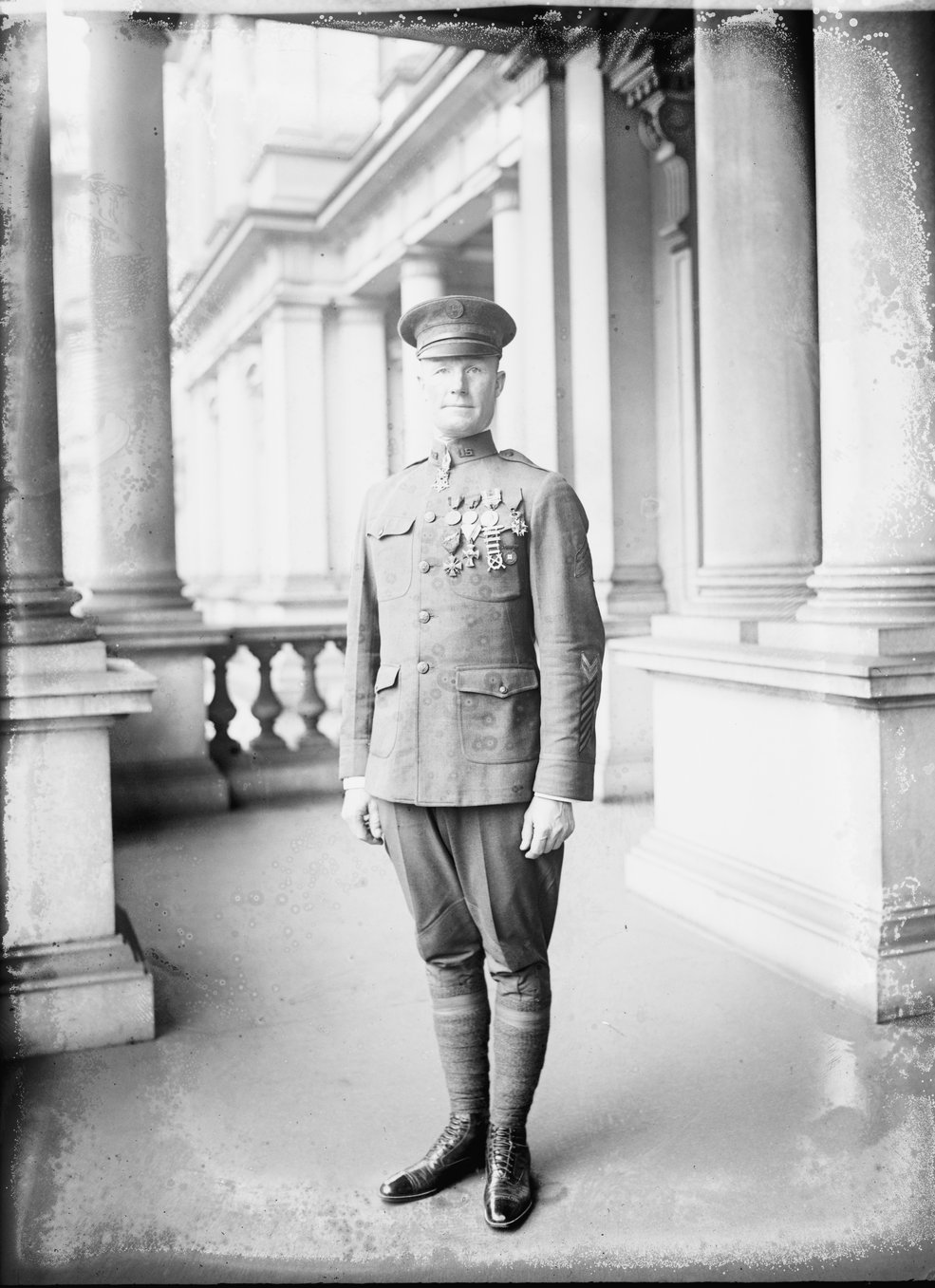
On the night of Nov. 11, 1922, the fourth anniversary of the armistice,1 the regular vaudeville program at the Palace Theater on Broadway ended and the lights went down.2 The Stars and Stripes were thrown onto the screen in the dark house.3
Gen. Bullard, who, the New York papers said, had commanded the division in which the sergeant served in France, told the story of his heroism, read his citation aloud and called him to the stage.1,3 The New-York Tribune wrote that the crowd “cheered and waved their flags.”1
The sergeant was Samuel Woodfill, born in Jefferson County, Indiana, in 1883.4 A year earlier, Gen. John J. Pershing had named him the outstanding hero of the war.2
That night a New York judge, Philip J. McCook, handed him the proceeds of a week of collections taken up in the Keith vaudeville theaters. Then McCook burned the mortgage on Woodfill’s house in Kentucky in front of the audience.1,2
The Associated Press counted “several thousand persons” in the seats. It reported that what McCook burned was a copy of a $3,000 mortgage.5
How the man Pershing picked out of the whole American army came to need a theater collection to keep his house is the part of Woodfill’s story the medal citation leaves out.
A stone house in Belleview
The Congressional Medal of Honor Society gives his birth date as Jan. 6, 1883, and his birthplace as Jefferson County, Indiana.4 Army records gave his home as Belleview, in the same county.6
In November 1921, after Pershing’s announcement made him famous, a news dispatch from Madison, printed in the Atlanta Tri-Weekly Journal, looked into his roots. It reported that Woodfill had been born in Monroe Township, the “son of Samuel and Christian Woodfill.” His mother’s maiden name was Custer.7
Cousins still living near Belleview told the reporter that young Samuel had been “neither ‘particularly good nor particularly brilliant.’”7
A long profile in the Washington Evening Star’s Sunday magazine that same month filled in the family. It named his father as John Samuel Woodfill. It said he had enlisted for the Mexican War in Company A of the 5th Indiana Volunteers, mustered in at Madison, and was wounded by a bayonet at Mexico City.8
The same profile said the father later served as captain of Company A of the 55th Indiana in the Civil War. According to the profile, the family lived in a stone house in Belleview, with three boys and two girls.8
The paper trail on the father does not line up neatly. The National Park Service’s Civil War soldiers index lists the captain of Company A, 55th Indiana, as “Woodfill, James S. G.”9
The 1869 report of Indiana’s adjutant general, describing Jefferson County’s home-guard regiment, says a company called the “Shelby Grays,” under a Captain Woodfill, went to Indianapolis in May 1862 to guard Confederate prisoners at Camp Morton.10
That report places Captain Woodfill’s company in the Fifty-Fourth Indiana, not the Fifty-Fifth, and says it fought at Richmond, Ky.10 The Park Service’s history of the 55th says that regiment fought at Richmond on Aug. 30, 1862, and was “mostly captured.”11
So the newspaper profile, the state report and the federal index give the father two different first names and the company two different regiment numbers. None of them is an original muster roll. The 1921 newspaper is the only one of the three that ties the captain to Samuel by name.
What is consistent is the picture of a boy raised around a soldier and his guns. The Evening Star profile said Samuel fired his first shot at age 7, with a muzzle-loading squirrel rifle, after his father handed it to him and said, “Now see if you can do better than your brothers.”8
He hit the bull’s-eye. “I was the happiest boy in the entire country that day,” he was quoted as saying.8
The profile said he went to school from age 7 to 14 and got as far as the fourth grade. His father died when Samuel was 13, and the boy went to work in the woods with his brothers. He saved for a Winchester rifle and won turkey shoots with it.8
Twenty-two years a regular
Woodfill joined the Regular Army in 1901, according to the Indiana historical marker near his birthplace.12 Where he signed up depends on the source. The 1921 Madison dispatch and the Evening Star profile both said Louisville.7,8 The Indianapolis Times said in 1923 that he joined at Fort Thomas, Ky.13
The marker says he served in the Philippines.12 He described it later in a hunter’s terms: “I stalked the ‘big game’ in the islands and bears in Alaska.”7
The Evening Star said that in Alaska he scored 96 out of a possible 100 on a skirmish run, the Army’s moving marksmanship test.8
In the summer of 1917 he was stationed at Fort Thomas, Ky. There he met Blossom Wiltshire.14
Her parents, Mr. and Mrs. William Wiltshire, lived at 167 Alexandria Pike in Fort Thomas. The couple married at the family home, which was decorated with American flags. The local paper reported that after a few days in the South, the bride would stay with her parents, and the lieutenant would report for duty at Charlotte, N.C.15
A 1919 item in the same Kentucky paper put the wedding on Dec. 26, 1917, and said he left for France “just a week later.”14 The Indianapolis Times reported in 1923 that the couple’s anniversary fell on Dec. 20.13 The 1919 report, written closer to the event by the paper that had covered the wedding, is the stronger of the two.
The railroad cut east of Cunel
By October 1918, Woodfill was a first lieutenant leading Company M of the 60th Infantry, 5th Division, in the Meuse-Argonne offensive.4,16
The division’s official history, published in 1919, records that the 5th took over its sector from the 80th Division overnight on Oct. 11–12. “Command passed to General McMahon at 6 a. m. of October 12th,” the history says.16
At once, the history says, “Companies K, L and M of the Sixtieth Infantry, with half a platoon of Company A of the Fourteenth Machine Gun, advanced up the narrow gauge railroad cut east of Cunel.” German machine-gun outposts ringed the town.16
The Medal of Honor citation describes what Woodfill did next. With his company stopped by machine-gun fire, he went forward alone toward a gun nest, leaving two men behind him. He worked around its flank and killed the crew.4
The citation says he took out a second nest and then a third. At the last one, two gunners turned their gun on him. “Failing to kill them with his revolver, he grabbed a pick lying nearby and killed both of them.”4
The accounts differ on the numbers. The citation, as printed in the War Department’s award list, credits him with three machine-gun nests.17 The division history says four, “killing more than a dozen Boche and capturing three others.”16
A 1921 Washington dispatch said he told President Warren G. Harding he had killed 19 Germans “in little more than an hour.”7 A 1923 Indianapolis Times headline said 20.18 The citation is the official record and the most restrained; the larger counts come from later retellings.
The date shifts too. The Medal of Honor Society and the division history both give Oct. 12.4,16 The 1921 Madison dispatch said Oct. 13.7
The Evening Star profile said that “on the way back he was severely wounded in the right shoulder.”8
The Medal of Honor Society records that Pershing presented the medal at his headquarters at Chaumont, France, on Feb. 9, 1919.4
Rep. Roy O. Woodruff of Michigan later told a story about it. Woodruff had been a captain at Bordeaux, in charge of the casual companies, and Woodfill was a first lieutenant in one of them.8
One day, Woodruff said, Woodfill came to him and said, “I’ve got to go to Chaumont,” without giving a reason. He was gone three or four days. About 10 days later the printed order crossed Woodruff’s desk, “and that was the first that any one at Bordeaux knew” that Woodfill had received the Medal of Honor.8
“Pulled out of oblivion”
The War Department’s award list, published in February 1919, gave Woodfill’s home as Fort Thomas, Ky.17 That August, the AP reported from Madison that “Captain Samuel Woodfill,” wearing four decorations for valor, was visiting his aged mother at Bryantsburg in Jefferson County.19
The Madison dispatch reported in 1921 that he had been “discharged in 1919 during the reorganization of the army” and had “re-enlisted immediately as a sergeant.”7
Two years later he was still a sergeant, assigned to the 36th Recruit Company at Fort Thomas. On Oct. 5, 1921, the War Department listed him among the noncommissioned officers chosen to carry the casket of the Unknown Soldier at Arlington.20
By the end of October, Pershing had singled him out. The AP reported that Woodfill had been told “his act of heroism was regarded by his former commander as ‘out-standing.’”6 Later accounts call it Pershing’s choice of “the outstanding soldier of the American expeditionary forces.”21 “Gen. Pershing has just pulled out of oblivion Sergt. Samuel Woodfill,” the Evening Star magazine began.8
He met President Warren G. Harding, and a Washington dispatch said he told the president how he had done it.7
In Madison, the dispatch said, local businessmen were working with Indiana Sen. Harry S. New to get him a captain’s commission again.7
The dispatch also quoted his wife. “He is a proclaimed hero,” Blossom Woodfill said. “He is a model husband and he isn’t afraid to wash dishes, either.”7
On Nov. 21, 1921, the Indiana Society of Washington gave him a reception. The Richmond Palladium reported that he was happy to meet 100 Hoosiers living in the capital, “‘folks from home,’ as he spoke of those who greeted him.”22
Ohio River Dam No. 36
The commission never came; he would leave the Army as a sergeant.18 In September 1922, reporters found Woodfill on a construction job on the Ohio River.23,24
He had taken a three-month furlough from the Army. He was working as a carpenter at $6 a day at Ohio River Dam No. 36, near Silver Grove, Ky.23
He told the New-York Tribune: “Well, frankly, I’m doing this because I need the money. My pay as sergeant–I’ve been a sergeant for twenty-one years–is $72 a month.”23
“That isn’t a great deal for a man and his wife,” he went on, “particularly when they are trying to pay for a little home.” They had bought the house about five years earlier, he said, after he came back from the Mexican border. They liked the country around Fort Thomas.23
His wife put it more plainly. “My husband went to work on the dam because he finds it necessary to raise the money to meet the payment on our home that will fall due on January 1,” she told reporters. “He could never do it on his sergeant’s pay.”24
The Washington Herald reported that he “stood in the shadow of losing his home on a $400 mortgage.” The $400 appears to have been the payment coming due rather than the whole debt; New York papers that November put the mortgage at $3,000.2,25
The Herald said someone had applied to the War Department to promote him to warrant officer, which would have let him retire on about $160 a month.25
The Tribune quoted him trying to make the best of it: “If the going seems pretty hard at times, all I have to do is to think of the home I’m working for.”23
The stories ran in papers from New York to Montana.23,24 Two months later, money collected in Keith vaudeville theaters “throughout the country” had paid the debt, and he was standing on the stage of the Palace.3,2,26
The New York Herald reported that after the $3,000 debt was paid, the rest of the roughly $10,000 went into a paid-up insurance policy and a trust fund overseen by McCook.3 The Tribune described McCook as Woodfill’s “friend and former ranking officer.”1
“When I get used to it”
A year later, Woodfill was ready to retire.27
In December 1923, the Washington Daily News reported that three soldiers, Sergeant Major Sewell, Sergeant McLaughlin and Sergeant Ackler, would accept demotion “in order that Sergt. Samuel Woodfill, 11th Infantry at Ft. Benjamin Harrison, Ind., may retire from 33 years of service in the highest noncommissioned rank.”27 The 33 years does not fit the other records: the state marker says he enlisted in 1901, and the Indianapolis Times put his service at 22 years when he was discharged that month.12,18
The Indianapolis Times asked him what he would do next. “I don’t know,” he said. “I have had no training except that I received in the Army. My life before I enlisted was spent on a farm, near Madison, Ind. I’ll just have to find out what I can do.”13
He added a word about his wife: “Our women folks, you see, have almost as hard a battle as the men, but in a different way.”13
On Dec. 22, 1923, at Fort Benjamin Harrison outside Indianapolis, he was discharged as a master sergeant. The Times reported that he stood at attention “in a drizzling rain” to receive his papers after 22 years of service.18
Brig. Gen. Dwight E. Aultman, the post commander, handed them over. “Sergeant, here is your order,” Aultman said. “Thank you, sir,” Woodfill replied, with a salute.18
The 11th Infantry then passed in review, which the paper called “a signal honor for an enlisted man.” Asked how it felt to be out of the Army, he said, “Well it’s going to be all right, I guess, when I get used to it.”18
His retired pay was $133 a month.18 Answering a letter, Indianapolis Mayor Shank said, “I sure would put that man on the police force and be glad to have him.” He added: “That man would make a whale of a good officer and be a credit to the force.”28
The record is not consistent on his final rank. The Daily News said the swap was for the “highest noncommissioned rank,” and the Times said he left as a master sergeant.27,18 A 1933 Times article said he had “retired as a captain in 1923.”21 The 1923 discharge-day report is the more direct source.
A book, and the house again
By the late 1920s Woodfill was looking for work again.29
In 1929 the Tri-County News of Grand Rapids, Ohio, told how a book about him came about. Woodfill called on Ohio’s attorney general, Gilbert Bettman, in Cincinnati and asked, “I need a job. Can’t you help me?”29
Bettman’s response, as the paper quoted it: “I felt ashamed for America that our superhero of the great war should be looking for a job.” Bettman took the idea of a book to an Eastern publisher, which sent the journalist Lowell Thomas to write it.29
The book, Woodfill of the Regulars, appeared in 1929 from Doubleday, Doran.30 Not everyone liked it. The Fort Snelling Bulletin, an Army post paper in Minnesota, wrote, “We are not at all impressed by the method in which Lowell Thomas has gone about telling the life story of Sergeant Samuel Woodfill.”31
That November, the South Bend News-Times reported that Woodfill was again “threatened with the loss of his home because he is unable to pay the mortgage.” A Pennsylvania reader had proposed paying an extra dollar for an autographed copy of the book, with the extra money going to Woodfill.30
Woodfill kept appearing at public events. In November 1933 the Indianapolis Times announced that he would unveil a portrait of Pershing at the Armistice Day ceremony in the shrine room of the city’s war memorial.21 The same article said he had “killed eight of the enemy,” yet another count.21
On July 4, 1937, his mother-in-law, Anna Wells Wiltshire, died at the Woodfills’ home in Fort Thomas. Her obituary called him “Capt. Woodfill.”32
Called back
When the United States entered the Second World War, the Army called Woodfill back. An AP headline in May 1942 read “York, Woodfill Return to Army As Majors,” pairing him with Alvin C. York. The War Department, the AP said, had given Army commissions to “two outstanding heroes of the first World War.”33
In June 1942 the Evening Star reported that Maj. Woodfill had been ordered to active duty with the infantry replacement and school command at Birmingham, Ala., starting July 1.34 The Indiana marker says he served as a firearms instructor and “quietly retired to Vevay in 1943.”12
On Aug. 13, 1951, his body was found in his apartment in Vevay. “Sheriff Ora Scudder said Mr. Woodfill apparently died several days ago,” the AP reported.35 The Medal of Honor Society gives his date of death as Aug. 10, 1951.4
He was buried near Madison, Ind.36
Fifty feet from Pershing
Four years later his body was brought to Washington. The AP described it as “raised from an obscure rural graveyard.”36
On Oct. 17, 1955, he was reburied at Arlington National Cemetery, “just 50 feet or so from that of Gen. Pershing.”36 The Medal of Honor Society gives his grave location as “34-642-A.”4
Evening Star reporter Richard Rodgers wrote about the years between the two wars. Woodfill’s retirement had gotten “scant notice,” he wrote, and the country in the Second World War had “too many fresh idols to bother with him.”37
“His death, undiscovered for several days, and quiet burial were the final snubs,” Rodgers wrote. “But yesterday his Nation made it up.”37
Army Secretary Brucker attended. The Fort Myer chaplain read a message from Vice President Nixon. A black caisson “drawn by six matched grays” carried the casket, followed by a riderless horse with boots reversed in the stirrups.37
Maj. Gen. Hanson E. Ely, retired, “Sam’s division commander in 1918,” helped place a wreath at the head of the grave.37 In 1922 the New York papers had given the division-commander role to Bullard; the Star gave it to Ely.1,3,37
The AP told one more story that week. In 1921, it said, Pershing was choosing pallbearers for the Unknown Soldier when he came across Woodfill’s name and exclaimed: “Why, I’ve already selected that man as the outstanding soldier of the AEF.”36 The story was being told 34 years later. It fits the October 1921 pallbearer list, but Hoosier First found no record from 1921 that quotes Pershing saying it.20
The record from those years shows what came next. Within a year of being Pershing’s choice, he was doing carpentry work on a river dam, and vaudeville audiences paid off his house. When he retired, three other soldiers took demotions so that he could leave at the highest enlisted rank.23,3,27
How he died
Samuel Woodfill died alone in his apartment in Vevay in August 1951. His body was found on Monday, Aug. 13. He was 68.35,38 The Medal of Honor Society gives his date of death as Aug. 10.4
The first Associated Press report, printed in the Evening Star, quoted the sheriff, Ora Scudder, as saying Woodfill “apparently died several days ago,” and added that “the cause of death was not immediately determined.”35 A later version of the AP story, printed in the Daily Alaska Empire of Juneau under the headline “World War I Hero Is Found Dead Of Heart Attack,” said the sheriff reported that Woodfill “apparently died several days ago of a heart ailment.”38
Hoosier First did not see a death certificate or a coroner’s report. The only cause in the record it read is the sheriff’s preliminary account of a heart ailment.
He was buried first near Madison, Ind. In 1955 his body was moved to Arlington National Cemetery.36