Seventy-Five Miles in the Rain
Before Marshall “Major” Taylor was champion of the world, he was a teenager on Massachusetts Avenue in Indianapolis, and the city’s tracks were closed to him. The hometown papers kept a record his own memoir doesn’t always match.
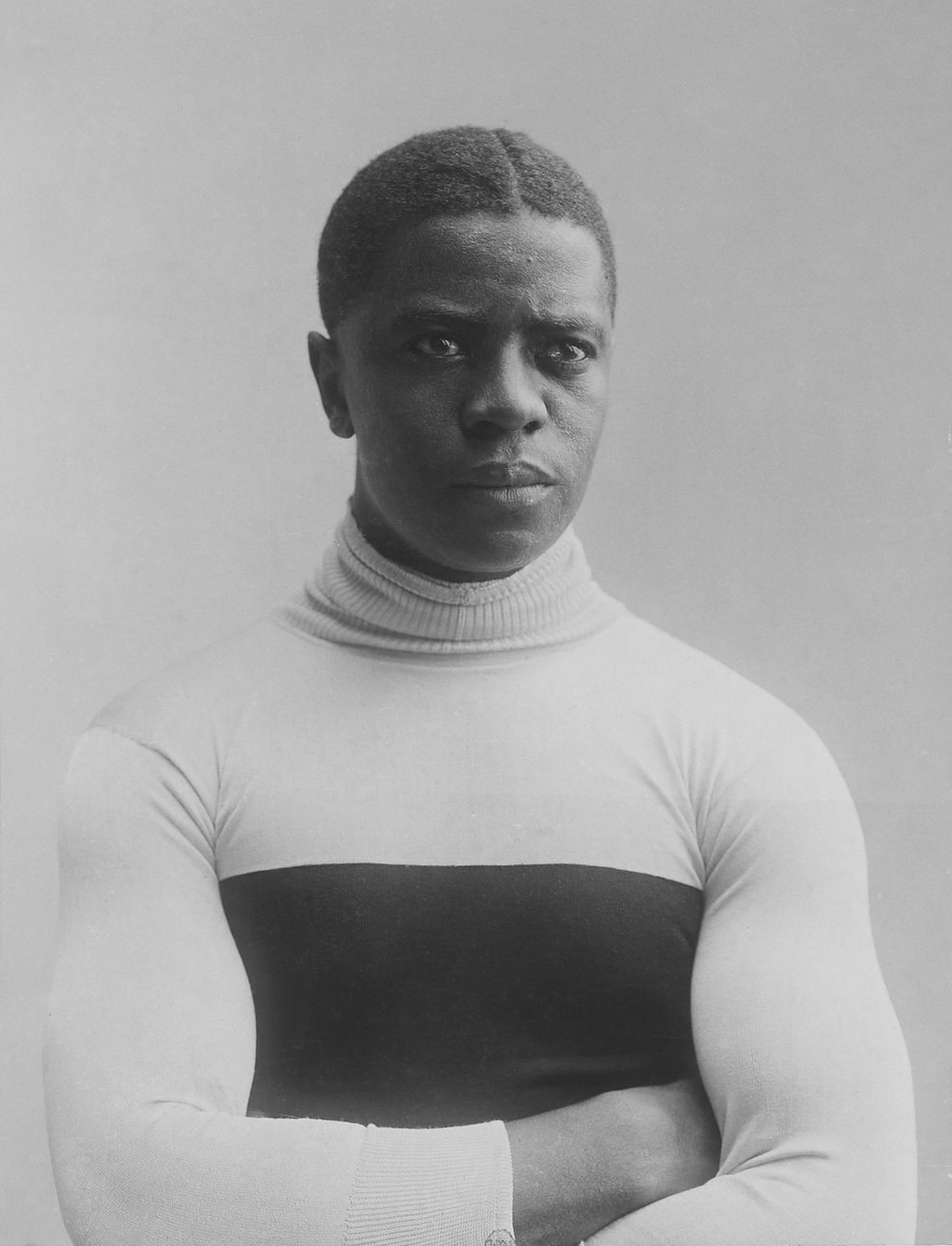
At 7 o’clock on a Sunday morning, June 30, 1895, 36 bicycle riders set out from Massachusetts Avenue in Indianapolis. They were headed for the new town of Matthews, Ind., 75 miles away.1,2,3
George Catterson, who ran the race, expected the winner to arrive in a little over four hours. The prize was a town lot in Matthews valued at $125.1
The rain started at McCords, and it did not let up. In places the water on the roads reached the riders’ sprocket wheels. Riders turned back. Only a dozen made it as far as Anderson, and eight were still riding at Daleville.1
At Muncie, where the leaders arrived around noon “covered with mud,” six riders were left. Five of them quit nine miles past Muncie.1
The sixth kept going. Past Muncie he hit a five-mile stretch of mud road and had to walk, carrying his 13-pound bicycle. When he finally rode into Matthews, eight hours and 20 minutes after the start, no other rider was within six miles.1
The Indianapolis Journal reported that his clothes were so caked with mud they weighed more than his bicycle. He “was taken in hand, rubbed down, bathed and blanketed.” The paper added: “His only accident was to break a spoke.”1
The Journal’s headline called him “A Colored Boy.” Its story began: “Major Taylor, colored, aged eighteen years, is the winner of the remarkable road race to Matthews yesterday.”1
The Freeman, Indianapolis’s Black weekly, reported that Taylor “won over thirty-six competitors, all white.”3 A week later it called him “the ‘Dark Secret,’ of Indianapolis.”2 The city’s See-Saw Cycling Club gave him a reception.3
Four years later, Marshall W. Taylor would be champion of the world. The Indiana Historical Bureau calls him cycling’s first African American champion.4
Two versions of the same race
Taylor told the story of the Matthews race himself in 1928, in his autobiography, The Fastest Bicycle Rider in the World. His account and the Journal’s, written the day after the race, don’t match.5
In the book, Catterson kept Taylor’s entry a secret because “had they known I was to start, none of them would have entered.” Taylor wrote that he hid until the starting pistol and then chased “the fifty-odd riders.”5
He wrote that other riders cursed him and threatened him, and that he broke away on a lonely stretch of road “with weeping willows on one side and a cemetery opposite.” He said friendly riders from Marion paced him over the last 20 miles.5
The book says the rain came in the last 25 miles and that he finished “more than an hour ahead of the second man.”5
The Journal counted 36 starters, not 50. It said the rain began near the start, at McCords, and “kept up all day.” It said the pacers came from Muncie, not Marion. Nobody finished second at all. “There was no winner of the second prize,” the paper said, “because none cared to go further.”1
The newspapers and the memoir also disagree about his age, and here Taylor is the better source. The Journal called him 18.1 He wrote that he was born in Indianapolis on Nov. 26, 1878, which would have made him 16 that June. He wrote, “I was only sixteen years old at the time.”5
For what happened on the road that day, the Journal’s report, published the next morning, is the stronger account. The memoir was written 33 years later. What it adds is what only he could tell: he wrote that on the lonely stretch he thought it would be “an ideal spot for my competitors to carry out their dire threats.”5
He also told what he did with the prize. He wrote that he took the deed home to his mother. She made him promise “that I would never ride such a long race again.”5
The other Major Taylor
Anyone searching the Indianapolis newspapers of the 1890s for “Major Taylor” runs into a second man with the name.
He sold men’s clothing. A Journal advertisement in 1892, when the cyclist was 13, read “MAJOR TAYLOR, Gentlemen’s Furnishings, 38 East Washington Street.”6 He later ran the Excelsior Laundry, and in 1895 he was elected president of the city’s Festival Association.7,8 The Journal reported that election on July 3, 1895, two days after it reported the cyclist’s win at Matthews.8
The cyclist knew all about him. In his autobiography, Taylor wrote that soon after his first race, the merchant called him into his office, accused him of “appropriating his name” and of getting his mail, and warned him: “If you do I will send you straight to Plainfield,” the state’s reformatory for boys.5
Taylor wrote that he began to cry. Then the merchant handed him a letter addressed to “Major Taylor.” It was the boy’s own, Taylor wrote, and the merchant had opened it.5
He wrote that a law firm later threatened him with the state prison at Michigan City unless he used his real name, Marshall. He promised to try, he wrote, but added, “But I can’t stop all the kids in town from calling me ‘Major.’”5
In the book, the story ends after his national championship races at Newby Oval. Taylor wrote that the merchant sent for him again, shook his hand and told him he was now free to use the name.5 He quoted an Indianapolis newspaper item about the two men. Hoosier First could not find that item in the digitized Indianapolis papers, so the meeting rests on Taylor’s account. The merchant’s ads and offices are on the record.6,7,8
The coachman’s son
The cyclist was born Marshall Walter Taylor, one of eight children, five girls and three boys, according to his autobiography.5 W. Milton Lewis, writing in The Freeman in 1904, said the family lived in North Indianapolis.9
When Marshall was 8, his father was working as a coachman for a wealthy Indianapolis family named Southard. Sometimes the father took the boy along when the horses needed exercise, and he became friends with the family’s son, Daniel, who was his age.5
Taylor wrote that he was eventually “employed as his playmate and companion.” He was dressed in the same clothes as Daniel, and when the other boys in the neighborhood rode bicycles, Daniel saw to it that he had one too.5
The boys went to the gymnasium at the Young Men’s Christian Association, and Taylor could not go in with them. “Owing to my color, I was not allowed to join the Y. M. C. A.,” he wrote. He watched his friends exercise from the gallery.5
“It was there that I was first introduced to that dreadful monster prejudice,” he wrote, “which became my bitterest foe from that very same day, and one which I have never as yet been able to defeat.”5
The Southards later moved to Chicago. His mother would not let him go with them, and he became “a common errand boy.”5
He taught himself trick riding. One day, he wrote, he did a fancy mount inside the bicycle shop of Hay & Willits in Indianapolis and drew the attention of Mr. Hay.5
Hay asked him to perform in the street in front of the store. The crowd got big enough that the police had to clear the street. Hay then offered him a job: “I will give you that $35.00 bicycle and $6.00 a week if you will come to work for me.” Taylor was making $5 a week on a paper route.5
He swept the store in the mornings and did tricks out front every afternoon at four, “in my nice new uniform.”5
The store sponsored an annual 10-mile road race, and its gold medal sat in the window. Taylor wrote that he once pinned it on his coat and strutted in front of the mirror for five minutes.5
When the race came, Hay pulled him onto the starting line as a joke, Taylor wrote. He was crying. Hay whispered to him: “I know you can’t go the full distance, but just ride up the road a little way, it will please the crowd, and you can come back as soon as you get tired.”5
He rode the whole course and won by about six seconds over the scratch rider, Walter Marmon. He wrote that he collapsed at the line and woke with the medal on his chest. He was 13. “My mother laughed and cried in turn,” he wrote, as he told her about it.5
A search of the digitized Indianapolis papers turned up no contemporary report of this first race, so the details rest on Taylor’s own account.
Captain of the club
By 1894 the young Taylor was a leader among the city’s Black cyclists. In March of that year, The Freeman announced that “the colored wheelmen of this city have formed a cycle club.” Its officers included Lewis Harris, president, and “Mr. Major Taylor, Captain.”10
In his autobiography, Taylor described the See-Saw Circle Club as having “more than 100 colored riders.” It held its own road races.5 A club by that name gave him his welcome-home reception after Matthews.3
The record and the ban
The Matthews race was itself the result of a ban, according to Taylor.5
He wrote that a few months earlier, Walter Sanger, a star rider, had set a one-mile record of 2:18 at the Capital City track in Indianapolis and was paid a bonus for it. Taylor’s friends then secretly brought him into a dressing room so he could try to beat it.5
With white friends pacing him on tandem bicycles, he wrote, he rode the mile in 2:11. Later that evening he rode a fifth of a mile unpaced in 23 3/5 seconds. He said he heard “several threatening remarks” from white riders on his way back to the dressing room.5
“Thereafter I was barred from ever competing again on any track in Indianapolis,” he wrote.5
The Indiana Historical Bureau’s marker on the Monon Trail, near the old track site, dates his record at the Capital City track to 1896.4 Taylor’s book places it a few months before the Matthews race, which the newspapers date to June 1895.5,1 A search of the digitized Indianapolis papers turned up no contemporary report of the record ride, so the year remains unsettled.
Leaving home, and coming back
After Matthews, Taylor went to work for Louis D. “Birdie” Munger, a former racing star who was building bicycles in Indianapolis.5
Taylor worked in the factory and helped out at Munger’s bachelor quarters, where touring racers often stayed. He wrote that Munger told people, “I am going to make him the fastest bicycle rider in the world.”5
He wrote that a member of Munger’s firm asked Munger “why he bothered with that little darkey.” The objections, Taylor wrote, led Munger to set up a factory in Worcester, Mass., and Taylor went with him.5
In Worcester, Taylor wrote, he was allowed to join the YMCA. He wrote that he “would shortly have dropped riding, owing to the disagreeable incidents that befell my lot while riding in and around Indianapolis,” if he had not been welcomed there.5
The Freeman’s account of the move is different. In August 1896 it reported that Taylor had just come back from Middletown, Conn., where he had worked for the past year for the Munger Bicycle Co. It said he had “accepted a similar position with the Hay & Willits Bicycle Co., Indianapolis.”11
So, by the Freeman’s account, he spent at least part of 1896 back home working in the store where he had started. The Indiana marker says he moved to Massachusetts in 1895 and won his first professional race in December 1896.4
“In deadly fear”
By the summer of 1897, the Journal was following Taylor as a national figure. Before that year’s national meet, it reported, “He will probably be the first colored man seen in a national championship event.”12
That October, The Freeman reprinted an item from the New York Sun. It said Taylor “rides in all his big races in deadly fear of his racing companions.”13
The Sun said he had been thrown and badly bruised in a race at Worcester, and that it “was charged that the accident was the result of a conspiracy.” It went on: “Taylor now ranks with the fastest men in this country, but the racing men, envious of his success and prejudiced against his color, aim to injure his chances whenever he competes.”13
Some tracks simply shut him out. In April 1898, The Freeman quoted the manager of Woodside Park in Philadelphia: “We shall bar colored riders and, unfortunately, Taylor is included.”14
That summer the national meet was held in Indianapolis, and Taylor decided not to go. The Freeman reprinted an item on his decision, credited to the Indianapolis Sentinel and quoting the Philadelphia Press. It said that years earlier a protest had been made against him “owing to his color,” and that “Taylor claims they did him the injustice of refusing him entry in the contests of that part of the country.”15
World champion
In August 1899, Taylor rode a mile behind a steam-powered pacing machine at Garfield Park in Chicago in 1:22 2/5. Newspapers reported it as a world record by 5 3/5 seconds.16
Days later he was in Montreal for the world championships. The Journal reported that 10,000 people saw the opening day. On Aug. 9 he lost the professional half-mile by inches. The Journal reported that part of the crowd “refused to accept it, claiming that Taylor had won.”17 Taylor later wrote that he had been “‘jockeyed’ out of a well earned victory.”5
On Aug. 10 he rode the professional one-mile world championship final against the Butler brothers, Nat and Tom, and the Canadian Angus McLeod.18
He sat in last place, then moved to second behind Nat Butler. McLeod went to the front with a rush. “Half way down the stretch ‘Major’ had the race well in hand,” the Journal reported. He won “by a wheel.”18
Two days later he declined a match race against Tom Summersgill of Leeds, England, who had won the amateur mile world championship on the opening day. The Journal called him “the English champion.”17,19 The Journal reported that “with no money in sight, without pacing, he refuses to take any chances,” and Summersgill won by default.19
Back at Newby Oval
Indianapolis kept claiming him. Even before Montreal, in June 1899, The Recorder, another Black Indianapolis weekly, reported that he was expected to arrive with an electric pacing machine and train at Newby Oval. It called him “the old Hoosier lad.”20
In 1900 he raced in Indianapolis again. In July the Journal reported that the crowd for a circuit meet at Newby Oval was “the largest that has ever gathered at Newby Oval.” Kimble beat him in the half-mile; Taylor won the two-mile handicap from scratch.21
On Sept. 6, 1900, Taylor and Owen Kimble, “the Kentuckian,” as The Freeman called him, crossed the line together in the one-third-mile national championship. “Two of the five judges decided that Taylor was the winner, but the other three declared it was a dead heat,” the Journal reported.22,23
The race was run again. The Freeman reported that Taylor “jumped to the front from the gun” and won by half a wheel. By the end of the meet, it said, he had won two national championships at Newby Oval, and that “five thousand people witnessed his magnificent performance.”23
He also had a reputation for something besides speed. In March 1900, The Recorder reported that he had turned down a $10,000 offer from French promoters to race at the Paris Exposition. He “refused the offer unless the riding on the Sabbath day was stricken out.”24 In his autobiography, he wrote that racing on Sunday “was against my religious scruples.”5
The same month The Freeman reported that his purchase of a house in a well-to-do part of Worcester had “created almost a consternation” there.25
The family left behind
The Indianapolis papers kept track of his family, though not always consistently.
In 1904, Lewis wrote in The Freeman that Taylor had been “very generous” to his sister and his parents, “both of whom died since he has been East, his father being recently killed by the railroad cars.”9
But in November 1910, The Freeman reported that “Wm. Taylor, of Chicago, was in the city last Tuesday, owing to the death of his father, Gilbert Taylor. He is the brother of the well-known Major Taylor.”26
The two reports can’t both be right about his father. The 1910 item names the father and the brother. The 1904 column was a reminiscence by an acquaintance. Neither is a death record, and Hoosier First could not settle the question from the records it found.
In December 1915 The Freeman noted a visit. Taylor had been in Indianapolis for two days on business, “also meeting old acquaintances,” before leaving for Chicago to visit his sister.27
“Life and limb”
“I was thirty-two years old when I retired,” Taylor wrote, “having at that time spent more than half my life battling on the bicycle tracks.”5 He wrote about how much the racing had cost him.
“In most of my races I not only struggled for victory, but also for my very life and limb,” he wrote. He listed the rivals he had beaten in match races and added, “Bald, Gardiner and Kiser drew the ‘color line.’”5
Asked whether he would live those years again, he wrote, “My answer in each case is ‘positively no.’”5
In 1911 The Freeman reported, citing the Worcester Telegram, that he had invented a steel automobile tire.28 In 1928 he published his autobiography.5
He died on June 21, 1932, according to the Indiana Historical Bureau, whose marker file cites his death certificate from Cook County, Ill. He was buried at Mount Glenwood Cemetery near Chicago. His grave had no marker until 1948, when a group of friends and colleagues paid to move his body and set a headstone.4
The Bureau also quotes the Chicago Defender’s obituary of July 2, 1932: “Taylor was a marvel on a bicycle. Riding against the fastest bicyclists of America, Europe and Australia, he won national and world championships against racial prejudice, unscrupulous tactics of riders and unfair decisions of officials.”4
What he wanted remembered
The last chapter of Taylor’s book is addressed to young people, “especially to those of my own race.”5
He wrote that he had “enjoyed the friendship of countless thousands of white men.” Then he added: “while the majority of white people are considerate of my people, the minority are so bitter in their race prejudice that they actually overshadow the goodwill entertained for us by the majority.”5
He wrote that no one of his color had been there to advise him when he started. “In a word I was a pioneer, and therefore had to blaze my own trail.”5
In 2009 the Indiana Historical Bureau, the Central Indiana Bicycling Association Foundation and the Indiana State Fair Commission put up a marker for him at 38th Street and the Monon Trail in Indianapolis. It says he set a one-mile record “at Capital City Track located here.”4
How he died
Major Taylor died on Tuesday, June 21, 1932, in Chicago. The Historical Bureau’s marker file gives the date and cites his Cook County death certificate.4
A Chicago report printed in the Northwest Enterprise of Seattle, a Black weekly, said he “died here Tuesday at the County Hospital after an illness of three months.” It said he had spent a month in Provident Hospital before he entered the County Hospital two months before his death, that he had been living at the Y.M.C.A., and that “he was penniless when he died.” An alderman who had once been one of his riding partners, the paper said, helped him get into the County Hospital.29 The Cleveland Gazette reported the same week that he had “died pennyless in the county hospital” after “a three months’ illness.”30
Neither paper named the illness. The Bureau’s notes cite the death certificate but do not quote a cause, and Hoosier First did not see the certificate, so this story does not state one.
He was buried at Mount Glenwood Cemetery. His grave went unmarked until 1948, when a group of friends and colleagues paid to move his body and set a headstone.4