The Name on the Tin
Madam C.J. Walker divorced Charles Joseph Walker in 1912 and kept his name. In 1913 her Indianapolis company’s lawyer was warning customers that someone else was using it, and telling them to look for her face on the box.
In the winter of 1913, readers of the Indianapolis Freeman, a Black weekly, found a short notice headed “A WARNING.”1 Its front-page masthead called it “A National Illustrated Colored Newspaper.”2
“Notice is hereby given,” it began, that a company in Louisville, Ky., was “in no way connected with” the Madam C. J. Walker Manufacturing Company of Indianapolis. The notice gave the Louisville firm two names, “the Walker-Larrie Company or Walker-Prosser Company.” It said “any statement made by Walker or any one representing him to the contrary is false in substance and in fact.”1,3
Then it told customers how to tell the difference. The genuine “Madam C. J. Walker Wonderful Hair Grower,” it said, was “in the yellow tin boxes bearing her trade-mark, duly registered, and entered under the Food and Drug Act.” It warned readers to beware of imitation or adulteration. And it ended with a test anyone could apply at a kitchen table: “EVERY box of the genuine Madam C. J. Walker’s Hair Grower has her face blown on it.”1,3
The notice was signed “F. B. RANSOM, Attorney for the Madam C. J. Walker Mfg. Company.” The same notice ran again on March 1, March 8, March 15 and March 22.3,4,5,6
The scanned text of the first printing is rough in places, but the March reprints are clean, and they match.3,4,5,6 The warning was about a man. It said “Walker” and “him.” It did not give his first name or initials. Hoosier First could not find, in the Chronicling America pages it searched, any notice that names him in full.
What the surviving record does show is that Madam Walker had divorced her husband, Charles Joseph Walker, the year before. She kept his name, for herself and for her company.7,8 By 1913 her name was her trademark, her face was on the tin, and her lawyer was telling the public that another Walker could not use either.
A story told in the Freeman
Most Hoosiers know the outline of Madam C.J. Walker’s life: the daughter of formerly enslaved parents, orphaned young, a laundress in St. Louis, then the founder of a hair-care company in Indianapolis that made her one of the best-known Black businesswomen in the country.8
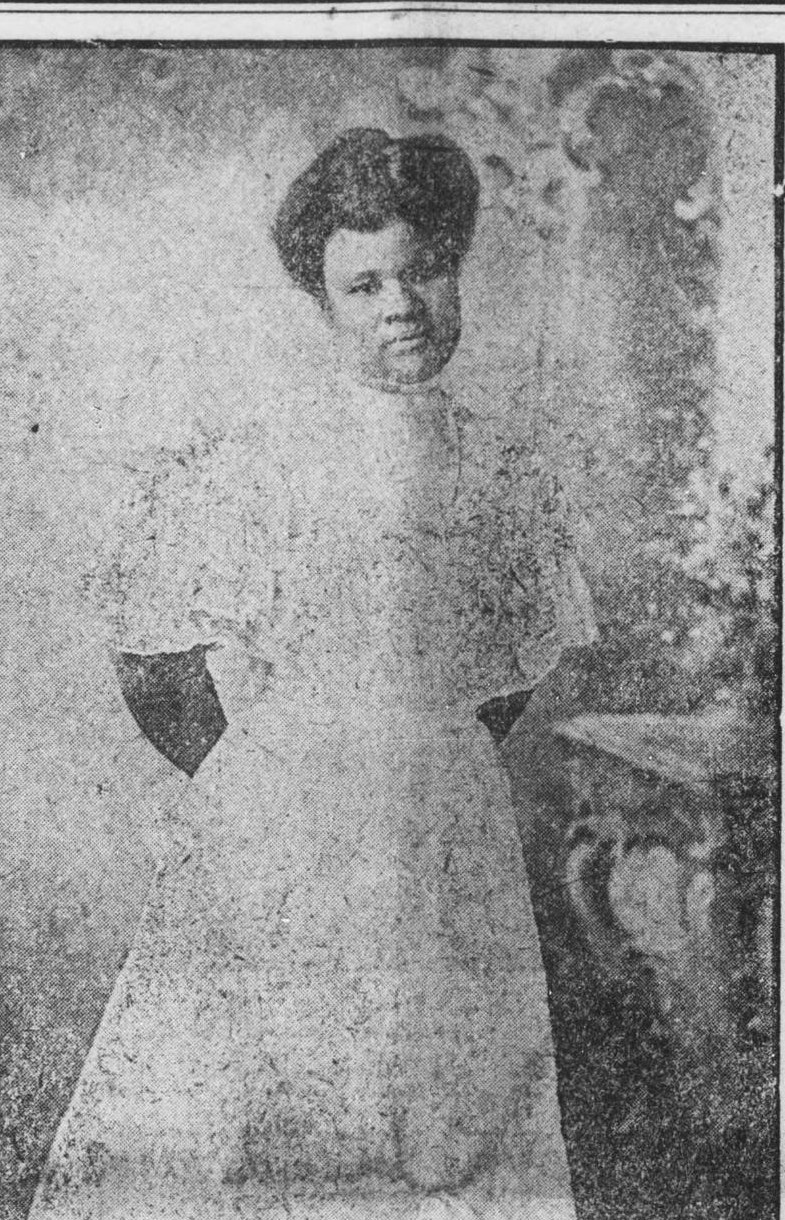
What is less often read is the version of that story that ran in Indianapolis while she was alive. On Nov. 11, 1911, the Freeman put her portrait on its front page under the caption “MADAM C. J. WALKER. The best known Hair Culturist in America. The first and only woman in the world to give $1,000 to a Colored Y. M. C. A.”2 (The OCR reads “51,000”; the figure on the page is $1,000, which matches her pledge to the Senate Avenue YMCA campaign.8,9)
The article beneath the portrait is a biography. It reads like one told by its subject or by someone close to her, and it stresses the things she wanted known.
It says she “was born in Delta, La., December 25, 1867,” to Owen and Minerva Breedlove.2 (The Encyclopedia of Indianapolis gives her birth date as Dec. 23, 1867.8 Hoosier First reports both and has not resolved the difference.) It says she was “left an orphan at the age of seven years, under the care of a sister and cruel brother-in-law,” and “married at the age of fourteen, in order to get a home.” It says she “was left a widow at the age of twenty, with one child, a little girl,” and lived in St. Louis for 18 years.2
It does not mention the second husband the Encyclopedia of Indianapolis records, John Davis, whom she married in 1894 and left around 1903.8
It then tells the founding story. “In 1905 she discovered a remedy for the growing of hair.” On July 19, 1905, she left St. Louis for Denver “to engage in the hair growing business.” After “many discouragements and obstacles,” she built “a fair business.” Then comes this sentence: “January 3, 1906, she was married to C. J. Walker.”2
Mr. Walker in the 1911 version
The 1911 profile is unusually specific about her husband. It does not describe him as the brains of the business. It describes him as a doubter who came around.
When she decided to take her products on the road, the Freeman said, she did so “notwithstanding she was discouraged by her husband and many patrons who said she would not be able to make her expenses from one town to another.”2
“Hence on September 15, 1906,” the article continues, “she started out, accompanied by her husband, to place her goods on the market; he having decided to join heart and hand with her to make her work a success, notwithstanding he could see nothing ahead but failure. After a few months on the road, he became thoroughly convinced that her method was the right one.”2
They traveled “for a year and a half,” the article says. The mail-order business grew so much that they settled for a time in Pittsburgh. She left her daughter in charge there and “began travelling again.” Then: “February 10, 1910, she came to Indianapolis, Ind., and was so impressed with the city and the cordial welcome extended to her she decided to make this city her home.”2
The secondary sources agree with the broad outline. The Encyclopedia of Indianapolis says she married Charles Joseph Walker, “a St. Louis newspaper sales agent,” in January 1906, and that he “moved to Denver and helped design her early advertisements.” It says she “adopted her husband’s surname and added the title ‘Madam’ for her new enterprise,” following “a custom affected by some businesswomen of the time.”8 The Indiana Historical Society’s guide to its Walker collection says she began marketing herself as Madam C.J. Walker in the spring of 1906, “perhaps to dignify her products, or to avoid being called by a condescending name like ‘Aunt Sarah.’”7
So the name was his, but the brand was hers from the beginning. And in the version the Freeman printed in 1911, she was the one who believed in it.
The house on West Street
The same 1911 profile described what she had built in Indianapolis in less than two years. Since arriving, it said, she had “purchased and paid for a beautiful home valued at ten thousand dollars ($10,000.00), adjoining which is a factory and laboratory, said to be the most complete of its kind in the United States.” It said she had 950 agents and that the business was “incorporated with a capital stock of $10,000.00, with an income of $1,000.00 per month, with Madam Walker as president.”2 Those figures are the newspaper’s and Hoosier First has not checked them against company records.
The story continued on an inside page. There, the Freeman said she had to seek larger quarters and so had “erected a large factory in the rear” of “her beautiful home on North West street.” She acted “in a supervisory capacity,” the paper said, with the immediate management “under a forewoman, an estimable and competent lady from Springfield, Ill.” It said “several girls” were employed, along with a bookkeeper and a stenographer.10
The Encyclopedia of Indianapolis gives the address as 640 N. West Street, now Dr. Martin Luther King Jr. Street, and says she remodeled a stable and warehouse behind the house into a factory and office.8
Four months before that profile, the house had its public debut. The Freeman of July 1, 1911, reported the “HOUSE-WARMING OF MR. AND MADAM C. J. WALKER.” The party was held “at their beautiful residence on North West street Tuesday evening, June 27.” Of 200 invitations, “more than 150 responded.”11
The report listed the presents. One line is “a beautiful silver vegetable dish” from a “Louisville friend,” presented by Mrs. Beatrice Barns and Mrs. Agnes Prosser. Among the out-of-town guests were “Mrs. Agnes Prosser and Mrs. George Barnes, Louisville, Ky.” At the end of the report, “Mr. and Madame Walker” thanked several people, including “Miss Lillian Prosser,” for “their valuable assistance rendered in receiving and caring for the great number of guests.”11
Madam Walker, the Freeman said, “was beautifully gowned” in black over white taffeta and received her guests “in the south parlor, while sweet strains of music from an Italian harp floated from behind an embankment of palms and ferns.”11
That summer, the house on West Street belonged to “Mr. and Madam C. J. Walker.” Their guests included people named Prosser from Louisville.
The company was incorporated that September. The Historical Society’s guide says the articles named three directors: Madam Walker, her daughter Lelia and C.J. Walker.7
1912
The Historical Society’s guide says that “after disagreements about the business and perhaps about other subjects, she divorced Walker in 1912.”7 Its inventory lists a folder titled “Divorce from C.J. Walker, 1912,” followed by “C. J. Walker correspondence, 1912–23” and “Affidavits re: C.J. Walker, 1913, 1918.”7 Hoosier First has not seen those papers. They are held by the Indiana Historical Society in Indianapolis.
The newspaper trail picks up in the fall. On Oct. 12, 1912, a one-sentence item appeared in the Freeman’s local column, “City and Vicinity”:12
“Madam C. J. Walker desires to state that she is in no way connected with the Walker-Prosser Mfg. Co., located at Louisville, Ky.”12
The next item in the same column reports that “Miss Anjetta Breedlove, of Denver, Colo., arrived in the city Tuesday, to make her future home with her aunt, Madam C. J. Walker, 640 North West street.”12
The item does not explain who ran the Walker-Prosser company. It does not say what it sold. Hoosier First searched Chronicling America for the company under two search phrasings, covering 1911 to 1916, and found no advertisement for it and no Louisville coverage of it. The only places the name turned up in the pages searched were Madam Walker’s own disclaimer and her attorney’s warning.
By then, Madam Walker had taken care that her name would carry weight. Eleven weeks after the disclaimer, on Dec. 28, 1912, the Freeman ran a column of testimonials under the heading “WHAT IS SAID OF MME. C. J. WALKER, THE WELL-KNOWN HAIR CULTURIST.”13
A Pittsburgh physician called her “a thorough business woman, reliable and honest.” A Pittsburgh pastor said she was “entitled to a gilt-edge certificate of character for Christian fidelity and business integrity.” A St. Louis woman who had known her “for some eight or ten years” called her “energetic and honest in her dealings.” A St. Louis lawyer called her “honest, truthful and perfectly reliable in all her dealings.” Dr. Sutton E. Griggs of Nashville wrote that she was “doing more for the race than any other living woman of today.”13
The column does not say why it was published. But it collected character references for a woman who was, that year, separating her business from a man who shared her name.
“Her face blown on it”
The warning that ran in February and March 1913 went further than the 1912 disclaimer.1,3,4,5,6
The 1912 item said Madam Walker had no connection with a Louisville company. The 1913 notice was signed by her lawyer, and it addressed the man as well as the company. It leaned on three things to make the point.
The first was the trademark. The tin boxes, the notice said, bore “her trade-mark, duly registered.”1,3
The second was federal law. The product, the notice said, was “entered under the Food and Drug Act.”1,3
The third was her own image: “EVERY box of the genuine” had “her face blown on it.”1,3
The company’s advertising leaned on that idea for years. In August 1914, a Freeman advertisement for “MME. C. J. WALKER’S WONDERFUL HAIR GROWER” said the products were “manufactured only by The Mme. C. J. Walker Mfg. Company, 640 N. West Street, Indianapolis, Ind.” It told buyers: “Make all Money Orders payable to Mme. C. J. Walker.”14
The Encyclopedia of Indianapolis reproduces three photographs of Madam Walker that the company used in its hair-grower advertising, two with long hair and one with short hair, as before-and-after pictures.8 Her own face, in other words, was the product’s proof.
The lawyer who signed the warning, Freeman B. Ransom, became her general manager and held that job until his death in 1947, according to the encyclopedia.8
Keeping the name
The Encyclopedia of Indianapolis makes the central point in a single sentence: “Though Walker divorced her husband in 1912, she maintained her married name for both herself and her company.”8
The record Hoosier First found suggests why that choice mattered. By 1912 “Madam C. J. Walker” was not just what people called her. It was the name on her tins, her money orders, her diplomas and her factory. A June 1913 Freeman advertisement for her training course read, “A DIPLOMA FROM Lelia College Of Hair Culture MADAM C. J. WALKER” followed by a phrase the OCR garbles but which appears to say the diploma “is a Passport to Prosperity.”15 Hoosier First treats that last phrase as probable, not certain.
To give up the name would have meant giving up the brand she had spent six years building. To share it would have meant letting someone else sell under it. The 1913 warning was her answer. She kept the name, and her lawyer went into print to say that only her company could use it.
Hoosier First found no evidence in the newspapers it searched of how the Louisville dispute ended. The Historical Society’s inventory lists affidavits about C.J. Walker from 1913 and 1918 and affidavits by him from 1922 and 1926.7 The guide says he died in 1926.7
What she did with it
The rest of the story is better known, and the Freeman tracked it.
In 1912, according to the Historical Society’s guide, “after being snubbed by Booker T. Washington,” she “seized the podium” at the National Negro Business League meeting in Chicago. The guide quotes her: “I am a woman that came from the cotton fields of the South. I was promoted from there to the wash-tub. Then I was promoted to the cook kitchen, and from there I promoted myself into the business of manufacturing hair goods and preparations.”7
Two years later, the Freeman reported that “Mme. C. J. Walker and daughter, Mrs. Leila Robinson, of New York,” had returned from the league’s meeting in Muskogee, Okla., where “Madame Walker was endorsed by the league as the foremost business woman of the race.”14
The same 1914 column noted that a young Indianapolis attorney had gone to Jackson, Miss., to seek a pardon for “a young colored man, the only son of a widowed mother,” and said, “Madam Walker financed the proposition.”14 (The OCR gives the lawyer’s initials as “S. B.”; Hoosier First has not confirmed whether this was F. B. Ransom and does not name him here.)
In early 1913 the Freeman reported that “Madame C. J. Walker writing from Sumter, S. C., says that the white people are generous in supporting enterprises by Negroes.”3 That year, the encyclopedia says, she traveled to Cuba, Haiti, Jamaica, Costa Rica and the Panama Canal Zone “to expand her international sales.”8
She moved to New York in 1916, but the company headquarters stayed in Indianapolis, run day to day by Ransom and the factory manager, Alice Kelly, according to the encyclopedia.8 By 1917, it says, she claimed to have trained nearly 20,000 women in the Walker System.8 She died May 25, 1919, and left $100,000 to more than 30 organizations and people, including $5,000 to the NAACP’s anti-lynching fund and $5,000 to the Alpha Home in Indianapolis.8
Her name is still on Indiana Avenue. The encyclopedia lists the Madam Walker Legacy Center in Indianapolis as a National Historic Landmark.8
What the record does not say
The newspaper record has gaps. Hoosier First wants to be specific about them.
It does not say who ran the Walker-Prosser company. The 1913 warning refers to “Walker” and “him.” The obvious reading is that it meant her former husband. But the notice does not give a first name, and Hoosier First has not seen the affidavits in the Historical Society’s collection. This story does not claim more than the notice says.
It does not say whether the Prossers who attended the 1911 housewarming had anything to do with the Walker-Prosser company. The name is the same and so is the city. That is all the record shows.
It does not say how the dispute ended.
What it does show is a sequence. In June 1911 the house on West Street belonged to “Mr. and Madam C. J. Walker.”11 In September 1911 C.J. Walker sat on the company board.7 In 1912 she divorced him.7,8 In October 1912 she told the public she had nothing to do with a Louisville company bearing the Walker name.12 In February 1913 her lawyer warned that statements by “Walker” were false and told customers to look for her face on the box.1
Why it matters
Madam C.J. Walker is usually remembered for what she built: a company, a factory, a sales force of thousands of Black women, and a fortune she gave away to schools and causes.
The 1912 and 1913 notices show something else she built: a name strong enough to defend. She took it from a husband in 1906.7,8 She made it famous over the next six years. When the marriage ended, she kept it, and she used the law, the newspapers and her own face to make sure it stayed hers.
Hoosier First found her side of the dispute in the Freeman, which had put her portrait on its front page in 1911. The other side was not in the pages it searched.
How she died
Madam C.J. Walker died on Sunday, May 25, 1919, at her country house in Irvington-on-Hudson, N.Y..16,17,8 The Monitor said she had bought the estate two years before.16
The Monitor, a Black weekly in Omaha, printed a special report from Irvington. It said she “had been ill for more than a year and her death resulted from a complication of ailments superinduced by a cold.”16 The New-York Tribune’s report the next day did not state a cause.17 Hoosier First did not see a death certificate, and the newspapers it read do not name a specific disease, so this story does not.
Her daughter, Lelia Robinson, was traveling when her mother died. The Tribune reported that F. B. Ransom had notified her “at Panama, of her mother’s death and the young woman is on her way home.”17