The Road to the Right
On April 6, 1862, Lew Wallace’s division marched all day and missed the first day of Shiloh. For the next 43 years, Wallace, Grant and the newspapers argued over one scrap of paper. Grant changed his account in a note to his memoirs.
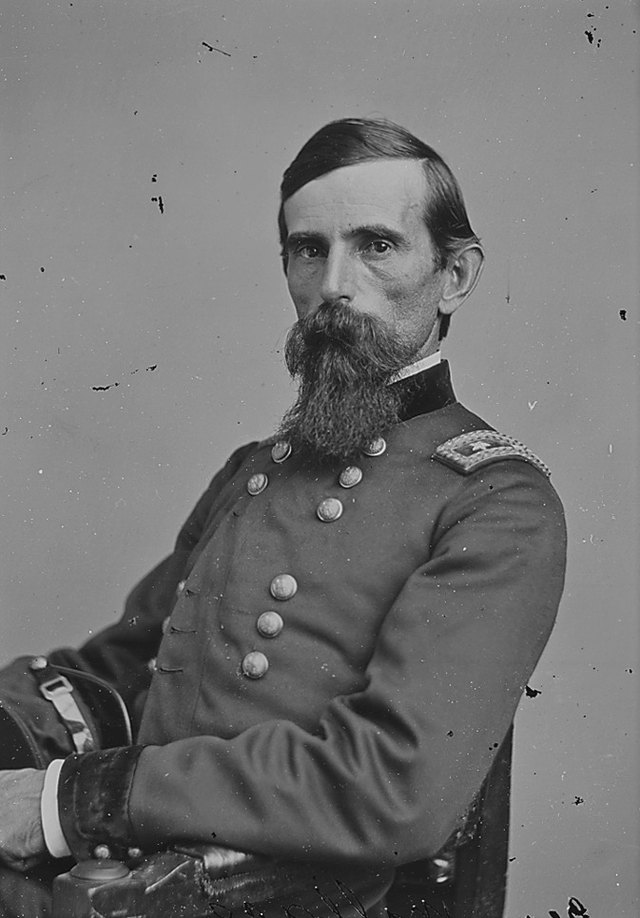
Eleven days after the Battle of Shiloh, Indianapolis readers opened the Daily State Sentinel to an official-sounding account of the fighting at Pittsburg Landing, Tenn. Near the end was a sentence about Lew Wallace, who a year earlier had been Indiana’s adjutant general.1,2
“Gen. Lew Wallace, at Crump’s Landing, six miles below, was ordered at an early hour in the morning to hold his Division in readiness to be moved in any direction to which it might be ordered. At about 11 o’clock the order was delivered to move it up to Pittsburg, but owing to its being led by a circuitous route, did not arrive in time to take part in Sunday’s action.”1
The same paragraph ran almost word for word that week in Worcester, Mass.,3 and, two days later, in the Richmond Palladium in Wayne County.4 Hoosier First found it in newspapers from Vermont to Nashville in the Library of Congress’s Chronicling America collection.
The sentence did not say who chose the route. That question would follow Lew Wallace for the rest of his life. It was argued in Indiana’s newspapers, in magazine articles, in a speech in Boston and in Ulysses S. Grant’s memoirs. It was still unsettled in 1905, when newspapers announced the death of the “Author of Ben Hur.”5
Hoosier First traced the argument through the papers. It turns on a single order, given aloud and delivered in pencil, that no one could later produce.
“Twelve or fifteen miles to go five”
The first accounts were not hostile. An Ohio paper, the Urbana Union, reported on April 16, 1862, that “Gen. Lew. Wallace had been ordered about twelve o’clock to leave Crump’s Landing and hurry up to the battle. He had to make twelve miles march, and did not arrive in time for any part of the action on Sunday.”6
One of Wallace’s own soldiers explained the delay in a letter home. On April 12, a correspondent with the 1st Nebraska, which belonged to Wallace’s division, wrote from the battlefield to the Nebraska Advertiser in Brownville. The division had been camped “five miles below, this, between Crump’s landing and Adamsville,” he wrote. Early on Sunday “we were wakened by the sound of cannon up the river, and ere long the rattle of musketry filled our ears.”7
“General Wallace did not get orders to advance with his Division until late in the morning,” he went on, “and then, having to march twelve or fifteen miles to go five, we did not reach the scene of conflict until night had ended the strife.”7
The next morning, he wrote, “we commenced the attack.”7 Other dispatches agreed that Wallace’s division opened the fighting on the second day. One reprinted in Washington said that “by seven o’clock Lew Wallace opened the ball by shelling from the positions he had selected the night before.”8
“A feeling of jealousy”
By May, an Indianapolis correspondent with the army could sense trouble. In a letter printed in the Indiana State Sentinel on May 12, 1862, he wrote that he had gone out with Col. McGinnis of the 11th Indiana “when Gen. Wallace’s division advanced towards Purdy, on Monday, and know something of the difficulties the General had to contend with in accomplishing his purpose without disobeying orders.”9
“As an Indianian, I feel proud of Wallace’s division,” he wrote. “But I fear that the reputation of the division has engendered a feeling of jealousy against its commander that will seek to annoy him and detract from his efficiency.”9
He gave an example. One of Wallace’s brigades was to be detached and left behind “to hold it during the advance,” “thus cutting down his command and depriving him of some favorite regiments. He has protested against the separation, and so have the regiments named, but it is said that Gen. Grant is inexorable.”9
The correspondent did not blame anyone for the march of April 6. But his letter shows that within a month of Shiloh, Wallace’s standing with Grant had become something an Indiana paper thought worth reporting.
Twenty years of charges
Over the next two decades, the charges hardened. In March 1885, the Indianapolis Journal reprinted a long defense of Wallace’s division by Col. Charles Whittlesey from the Cincinnati Commercial Gazette, under the headline “Wallace at Shiloh Church: A Strong Defense Against the Grant-Sherman Charges of Tardiness.”10
Whittlesey quoted what had been said about the division. From Badeau’s history, as he cited it: “Lew Wallace was equally amiss. He, who had been upon the ground a month, excused himself that he had taken the wrong road. Captain Rowley and Colonel McPherson put him right at 1 o’clock, and it took him till 7 that night to march five miles.” From the National Tribune: “Lew Wallace, to whose shameful tardiness—to call it by no harsher name—was mainly due the cause of the repulse of the first day.”10
He quoted William T. Sherman’s memoirs, in which Sherman wrote that Grant had told him on the morning of the battle that he had ordered Wallace’s division “to cross Lick (Snake) creek so as to come up on my right, telling me to look out for him. We had waited all day for him.”10
“Themselves and their friends have, during that period, endeavored to throw the blame of the defeat of Sunday upon General Lew Wallace,” Whittlesey wrote. He argued that “a fair and candid investigation, such as General Grant is generally inclined to make, would have shown that Wallace was not lacking in any respect on that day.”10
Grant’s first account
Whittlesey’s defense came two months after Grant himself had weighed in. His article “The Battle of Shiloh,” written for the Century magazine, was reprinted in the Indianapolis Journal on Jan. 21, 1885.11
Grant wrote that on the morning of April 6, on his way up the river, he had stopped at Crump’s Landing and told Wallace to have his troops ready to move. On reaching the battlefield at about 8 a.m., he wrote, “Capt. Baxter, a quartermaster on my staff, was accordingly directed to go back and order Gen. Wallace to march immediately to Pittsburg by the road nearest the river. Baxter made a memorandum of his order.”11
When Wallace had not appeared by about 1 p.m., Grant sent two staff officers to find him. “They reported finding him marching toward Purdy, Bethel, or some point west from the river, and further from Pittsburg by several miles than when he started.”11
Then Grant addressed Wallace’s version. “General Wallace has since claimed that the order delivered to him by General Baxter was simply to join the right of the army,” he wrote, “but this is not where I ordered him nor where I wanted him to go. Even if he were correct as to the wording of the order, it was still a very unmilitary proceeding to join the right of the army from the flank instead of from the base.”11
“Later in the war,” he added, “General Wallace would never have made the mistake that he committed on the 6th of April, 1862.”11
The letter from a widow
Grant was also writing his memoirs. In a note printed in them, he said that he had received a letter.12
It came from the widow of Gen. W.H.L. Wallace, “the gallant general who was killed in the first day’s fight on the field of Shiloh.” She sent Grant a letter that Lew Wallace had written to her husband, dated the morning of April 5, the day before the battle.12
The letter showed, Grant wrote, that “General Lew. Wallace was making preparations for the emergency that might happen for the passing of reinforcements between Shiloh and his position.” Wallace had sent it over the road running from Adamsville toward the Pittsburg Landing and Purdy road, and offered to send cavalry so that troopers could learn the road and “act promptly in case of emergency as guides to and from the different camps.”12
Then came this sentence:
“This modifies very materially what I have said, and what has been said by others, of the conduct of General Lew. Wallace at the battle of Shiloh. It shows that he naturally, with no more experience than he had at the time in the profession of arms, would take the particular road that he did start upon in the absence of orders to move by a different road.”12
Grant still thought Wallace had made a mistake, which “probably caused his apparent dilatoriness”: advancing too far after the battle line had fallen back. But he now conceded something about his own order. “My order was verbal, and to a staff officer who was to deliver it to General Wallace, so that I am not competent to say just what order the General actually received.”12
He added: “If the position of our front had not changed, the road which Wallace took would have been somewhat shorter to our right than the River road.”12
The note is signed “U. S. Grant, Mount MacGregor, New York, June 21, 1885.”12
“A Manly and Explicit Declaration”
The Century printed the same statement as a card from Grant in its September 1885 issue. On Sept. 2, 1885, the Indianapolis Journal reprinted it under the headline “General Grant’s Amende: Gen. Lew Wallace and Gen. McCook at Shiloh—A Manly and Explicit Declaration.”13 Smaller papers carried it into October.14
Hoosier First compared Grant’s two published accounts. The main text of the memoirs repeats much of the Century article, but not all of it. The sentence calling Wallace’s march “a very unmilitary proceeding” is not in the memoirs. Where the Century had said Wallace “would never have made the mistake,” the memoirs say he “would not have made the mistake.”11,12 The memoirs also keep a sentence that the Century printed too: “I presume his idea was that by taking the route he did he would be able to come around on the flank or rear of the enemy, and thus perform an act of heroism.”12
So Grant softened his account twice: once in the text, and again in the note.
The scrap of paper
The concession did not end the argument. It moved it to the order itself.
In 1886, Wallace spoke in Boston. The New York Mail and Express printed his account on Oct. 29, and the Indianapolis Journal reprinted the exchange that followed on Nov. 6, 1886.15
Wallace described the moment Grant’s quartermaster handed him the order. “The paper was a part of a sheet of foolscap, dented with boot heels, and soiled with tobacco. The writing was in pencil, and no signature was appended.”15 He said he passed it to one of his colonels and that it ended up with his adjutant general, “who probably put it under his sword-belt and lost it during the day. It could not have been foreseen that its production subsequently would have saved me so much pain and mortification.”15
Then he quoted it from memory: “You will leave a sufficient force at Crump’s Landing to guard the public property there. March there and form a junction with the right of the army. Form your line of battle at right angles with the river, and be governed by circumstances.” “Not a word about Pittsburg Landing,” Wallace said; “not a word about the river or lower road.”15
The quartermaster answered. Gen. A.S. Baxter, the officer who carried the order, wrote that Grant’s adjutant general, Rawlins, had dictated it, and that Baxter wrote it down and Rawlins signed it. As Baxter remembered it, the order was to “march his command at once by the river road to Pittsburg Landing and join the army on the right.” He said Wallace told him that he “knew the road and had put it in good order.”15
“The written order, when delivered to Gen. Wallace,” Baxter wrote, “was on a clean sheet of paper, and not ‘dented with boot-heels or soiled with tobacco.’”15
The two men disagreed about the river road, about the signature and about the condition of the paper. But both versions of the order, Wallace’s and Baxter’s, sent the division to the right of the army.15
The obituaries
Lew Wallace died at his home in Crawfordsville on the night of Feb. 15, 1905.5 The report of his death said that when his physician told him he was dying, he said, “I am ready to meet my maker.”5 His body lay in his library, on a catafalque draped with a flag “carried through the civil war by troops commanded by General Wallace,” the Cairo Bulletin reported.16 The funeral was private. “Until noon the body lay in the library building and was viewed by thousands,” one report said. “Business was suspended and the city did honor to the memory of the dead.”17
The obituaries could not agree on Shiloh.
Washington’s Evening Star, which ran a long biographical sketch, repeated the old charge. Wallace had been ordered to come up on Sherman’s right, it said, “but he lost his way, and did not arrive until the night.”18
The Washington Times, the same day, described the dispute without settling it. “His failure to arrive on the field from his headquarters at Crump’s Landing, six miles from Pittsburg Landing, and take part in the action of the first day, resulting, as his critics declared, in Grant’s being driven back, caused one of the bitterest controversies of the war.” But Grant, it added, “despite the unfortunate misunderstanding, retained the utmost confidence in him.”19
Others avoided the question. The Tazewell Republican in Virginia said only that “He was present and fought at the second day of the battle of Shiloh.”20 The Billings Gazette in Montana said that “his part in the great battle of Shiloh was conspicuous and is familiar to those who know the history of the war.”2
What the record shows
The papers Hoosier First reviewed do not settle what the order said. The written order was lost on the day of the battle, by Wallace’s account.15 The man who gave it said, in the last weeks of his life, that he could not be sure what words had reached Wallace.12 The man who carried it and the man who received it remembered it differently 24 years later, though both agreed it pointed to the right of the army.15
What the record does show is how a single sentence about “a circuitous route” in April 1862 became a 43-year argument.1 Indiana’s newspapers carried both sides: the State Sentinel correspondent who saw “jealousy” in May 1862,9 the defense of the division in 1885,10 Grant’s “amende” that September,13 and Wallace’s and Baxter’s dueling memories in 1886.15
Grant’s own words changed the most. In January 1885 he called Wallace’s march “a very unmilitary proceeding.”11 By June he had written that new evidence “modifies very materially” what he had said.12 He dropped the harshest line from his memoirs.
Hoosier First corrected obvious OCR errors in newspaper quotations, for example “neareet” to “nearest” and “ofteuer” to “oftener,” without changing their meaning.
How he died
Lew Wallace died at his home in Crawfordsville on the night of Feb. 15, 1905, at 77. His wife, his son Henry and his physician were with him.5,19
The dispatches described a long decline rather than a sudden death. For more than a year, the Crawfordsville report said, “he had been unable to properly assimilate food,” and his health had been “waning for several years.”5 The Washington Times said that he had consulted specialists in New York more than a year earlier, and that “while physicians refused to say from what disease the general was suffering, it is known that he had cancer of the stomach, but the fact was never told him.”19
His longtime physician, Dr. Ristine, gave a narrower answer. He said “the direct cause of the general’s death was exhaustion, resulting from starvation,” and blamed Wallace’s long habit of smoking as the original cause of his illness. Wallace had last been out on the streets on Nov. 4, the doctor’s account said, and had been confined to bed soon after.2 Hoosier First did not see a death certificate.