Teacher vs. Pupil
John Wooden learned the game in Martinsville on a ball his mother made from rags and stockings. Indiana newspapers followed him from high school forward to Purdue’s all-America guard to a young coach, years before UCLA made him famous.
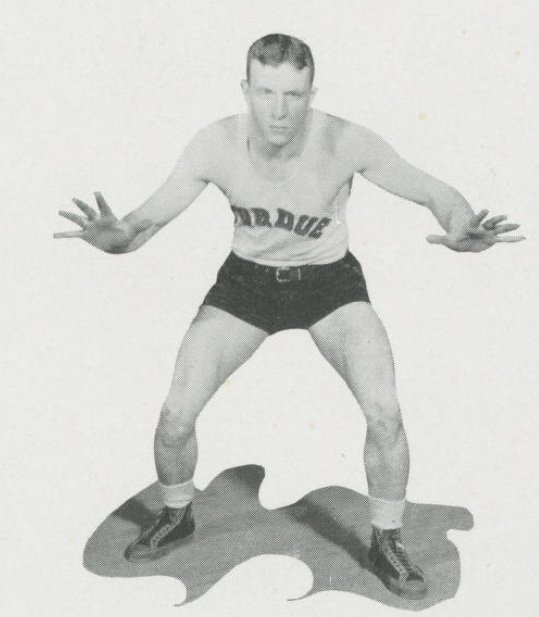
In January 1933, a short item ran on the sports page of The Indianapolis Times under the heading “WOODEN VS. CURTIS.” It said that “Johnny Wooden, Martinsville’s basketball hero,” would bring his high school team from Dayton, Kentucky, back to Martinsville the next Tuesday night to play Glenn Curtis’ Artesians in a charity game. “It will be teacher vs. pupil,” the item said, “the former Purdue flash learning his cage antics from the veteran Curtis.” Fans would set their own admission price at the gate.12
The notice took up a few lines. The young coach in it would later be known as the man who won ten national championships at the University of California, Los Angeles. In 1933, though, he was a high school coach in his first season, coming home to play against his old coach. This story follows him mostly through the Indiana newspapers of his own time, and then through the record UCLA and the White House left when his long career ended.
A ball made of rags
John Robert Wooden was born on October 14, 1910, in Hall, Indiana, one of four sons of a farmer and a housewife, according to the obituary UCLA published on the day he died.1 He grew up in Hall and in the nearby towns of Centerton and Martinsville.1
UCLA’s account of his childhood includes two details that Wooden told again and again. The first is the ball. His mother, UCLA wrote, made the first basketball for Wooden and his brothers “by tying together old rags and black cotton stockings.”1 The second is his father. Wooden said he learned from his father what true leadership was: when to be firm, when to be flexible, when to have the strength to be gentle, and when to have the strength to force compliance.1 He was also known for reciting his father’s “two sets of three”: “never lie, never cheat, never steal” and “don’t whine, don’t complain, don’t make excuses.”1 His father also passed along a seven-point creed. The point Wooden said he used most in his coaching was “make each day your masterpiece.”1
The Rubber Man of Martinsville
Wooden began playing high school basketball at Martinsville, where, UCLA wrote, they called him the “Indiana Rubber Man” because every time he went down on the court he bounced right back up.1 He won all-state honors three years in a row. Martinsville finished second in the state in 1926, won the state title in 1927, and finished second again in 1928.1
The Indiana papers of 1927 give a sense of what that title looked like from the stands. The South Bend News-Times of March 20, 1927, carried a report from the state tournament in Indianapolis under the headline “ARTESIAN CITY FIVE CRUSHES BEARCATS IN THRILLING GAME.” The Artesians were Martinsville. The Bearcats were Muncie. The paper wrote that Martinsville “surpassed at the defensive game, and played a beautiful cautious offense, never taking a shot unless the chances were better than even for making it.” Muncie’s forward Mace starred, and “Wooden, Martinsville, forward, also put up a brilliant game, securing four buckets and two charity tosses.” Martinsville led 17–12 at the half. In the second half the two teams were “battling desperately,” with Martinsville holding the ball and playing a deliberate game to protect its small lead. “The gun sounded as Peck Bratton sunk a free throw for Muncie,” the report said, “and in an instant the floor was covered with the frenzied” crowd.2 (The scanned text of the final score is not legible enough to quote here.)
The 1928 final went the other way. Martinsville reached the title game again and lost it. Decades later, Wooden said that losing the 1928 title game “was the most disappointing thing that ever happened to me as a player.”1
His coach through those years was Glenn Curtis. In March 1932, after Martinsville had been knocked out of the state tournament, an Indianapolis Times columnist wrote that he felt “very sorry for Mr. Glenn Curtis,” because it had been “a more or less known fact that Mr. Curtis did not have any Woodens, Eubanks or Suddiths this year.”8
Purdue’s floor guard
Wooden went to Purdue University in Lafayette. UCLA reported that he won letters in basketball and baseball as a freshman.1 By December 1929, as a sophomore, he was already being singled out. Previewing a game at Butler fieldhouse, The Indianapolis Times wrote that, with three veterans back from the previous year’s Western Conference runner-up team “and Johnny Wooden of Martinsville, a sophomore, showing brilliant prospects at floor guard,” Piggy Lambert’s team was “being boosted for sectional and national title honors.”3
The prospects came good quickly. On February 27, 1930, a United Press report from Lafayette ran under the headline “Wooden Leads Purdue Five to Easy Win.” Purdue had beaten Northwestern 29–16, its seventh straight conference victory, and “virtually clinched the Western Conference basketball title.” The report said “Johnny Wooden, Purdue guard, led the scoring with six field goals.”4 The same papers called the Western Conference the Big Ten.
In December 1930, Purdue named Wooden and Harry Kellar of Chicago as co-captains for the coming season. The announcement noted that “Wooden was an all-America floor guard last season.”5 A few weeks later, the Times ran a basketball instruction column by Everett S. Dean, the basketball coach at Indiana University. Dean opened it with Wooden. “JOHNNY WOODEN, all-conference guard from Purdue and all-America selection for last year, is the greatest dribbler of the middle west,” Dean wrote. Wooden combined speed and cleverness with the dribble, Dean said, to become the third-highest scorer in the Big Ten the year before, “and that from a guard position.” Dean wrote that the dribble, “as Wooden uses it, offers one of the most dangerous offensive weapons.”6
Four H’s and two A’s
Wooden’s college record was not only on the floor. In February 1932, a Times columnist reported that “Mr. Johnny Wooden is about the best basketball player around these parts” was “common, everyday knowledge,” but that “now it comes to light that the brilliant Purdue hoopster also is a Barry Wood in the classroom.” The columnist wrote that Wooden’s grades for the semester just ended showed “four H’s and two A’s,” and explained that this meant “bouncing Johnny has an average grade of more than 95 per cent,” with H an honor grade.7
The scoring record
The 1931–32 season was Wooden’s last, and he went into its final game chasing a record. On March 7, 1932, a United Press report from Chicago said that “the sensational Johnny Wooden, Purdue’s all-America guard, must score only fifteen points tonight” against Chicago “to grab the all time conference individual scoring record.”8 On the same page, the Times columnist wrote that “a lot of Big Ten coaches are going to breathe easier after tonight,” because Wooden would be playing his last game for Purdue.8
He got the record. Three days later, the Times printed a list of the season’s achievements for Purdue, which had won the 1932 Big Ten championship. Item seven read: “Johnny Wooden, co-captain and floor guard, set a new all-time individual high scoring record for the Big Ten with 154 points in twelve games.” Another item noted that the title was Purdue’s “second undisputed title in three years.” The same page reported that the Lions Club banquet for the team that night would pay special tribute to Wooden and Kellar, “brilliant co-captains,” and that the coach, Ward Lambert, would make the letter awards.9
On March 22, 1932, the Times ran the selections of a new all-America board of basketball, chosen by eight coaches and written up by Dr. Walter Meanwell. Indiana, “the ‘cradle of basketball,’” had taken two of the five places, the article said: Wooden at guard and Ed Krause of Notre Dame at center. One of the forwards was Richard Linthicum of the “University of California (Los Angeles branch),” the school Wooden would later coach. Meanwell wrote that “Wooden was the outstanding choice,” and that “if the most brilliant amateur basketball player in the country was to be selected, the name of the sensational Purdue senior outshines all others. He can do anything with a basketball that anybody else can do and has a number of amazing tricks of his own.”10
UCLA’s obituary summed up those years. Wooden was an All-American from 1930 to 1932, captain of Purdue’s 1931 and 1932 teams, and led the Boilermakers to two Big Ten titles and the 1932 national championship. He was named college basketball’s 1932 Player of the Year and was inscribed on Purdue’s academic honor roll.1
The Big Ten medal
Wooden’s college career ended at commencement. A United Press item from Lafayette on June 14, 1932, reported that “John R. Wooden, Martinsville, Ind., three-time all-American floor guard on Purdue basketball teams,” had been awarded the Big Ten medal “for combined proficiency in athletics and scholarships” at Purdue’s 58th annual commencement that day.11
Shortly after graduating, he married Nell Riley. UCLA wrote that the two had met at a carnival when he was 15, and that they stayed together until her death in 1985. He called her his “lucky Nell,” and he never began a game without finding her in the stands and getting a wink and an OK signal from her.1
Coach Wooden, player Wooden
Wooden began coaching and teaching at Dayton High School in Dayton, Kentucky. He coached several sports there. UCLA noted that the Dayton basketball team gave him the only losing season of his entire career as a player or coach.1 That was the team he brought home to Martinsville in January 1933 for the charity game against his old coach.12
He was still a hero in Indiana basketball. In January 1934, an Indianapolis Times column reported a newspaper interview with Fuzzy Vandivier, a star of Franklin’s “wonder five” of 1920 to 1922. Vandivier named Griz Wagner as the greatest Indiana high school coach of all time and ranked Glenn Curtis just below him. He picked “Johnny Wooden, former Martinsville and Purdue hardwood ace, as the greatest player an Indiana high school ever turned out.”13
By December 1934, Wooden was back in Indiana in two roles at once. A reader’s letter in the Times that month predicted that Central of South Bend would be the team of the season and asked the columnist to report on one of its games, since “John Wooden, the Central coach, always will be of interest wherever basketball is appreciated.” The writer, who signed off “A JOHN WOODEN FAN,” suggested readers welcome him “in his initial venture as a coach in a state where teams are drilled to perfection.”14 On the same page, a preview of a Sunday afternoon game at the Indianapolis Armory said that the Huff-Colonials of Louisville would assign Joe Hoffman, a former University of Maryland player, to guard “Johnny Wooden, Kautsky ace,” when they played the Kautsky A.C.s, an Indianapolis team.14 That winter, the same newspaper page placed him both on the South Bend Central bench and in the Kautskys’ lineup.
UCLA’s obituary does not mention South Bend. It moves from Dayton straight to the Second World War, when Wooden served as a lieutenant in the U.S. Navy and spent time aboard the USS Franklin in the South Pacific. After his discharge in 1946, he coached for two seasons at Indiana Teachers College, now Indiana State University. Then he went to UCLA.1
Westwood
The numbers from UCLA are the ones most people know. His teams won seven straight NCAA championships from 1967 to 1973, and ten titles in his last twelve seasons: 1964, 1965, 1967 through 1973, and 1975.1 In the early 1970s the Bruins won an NCAA-record 88 games in a row, a run that included undefeated 30–0 seasons in 1971–72 and 1972–73. They also won 38 straight NCAA tournament games. Wooden retired after the 1975 season with a UCLA record of 620 wins and 147 losses. In the ten seasons he coached at Pauley Pavilion, the Bruins lost only twice at home.1
His players included Kareem Abdul-Jabbar, then known as Lew Alcindor, and Bill Walton, along with Willie Naulls, Walt Hazzard, Gail Goodrich, Sidney Wicks, Jamaal (Keith) Wilkes and Marques Johnson.1 “He taught in a very simple way,” Abdul-Jabbar said in an interview with UCLA. “He just used sports as a means to teach us how to apply ourselves to any situation.” He also said that Wooden “was more like a parent than a coach.”1
UCLA recorded some of his habits. He began each season with a session on how to put on socks and shoes properly. “This is a game played on your feet,” he said. “If you get blisters, you can’t play the game.”1 He disliked the nickname “Wizard of Westwood.” “I’m no wizard, and I don’t like being thought of in that light at all,” he told the director of the UCLA History Project in 2006. He preferred to be called “coach.” “Coach is fine,” he said.1
He decided to retire during the 1975 tournament. After a 75–74 double-overtime win over Louisville in the national semifinal, he found that he did not want to talk to the media, a feeling he said he had never had before. He went to the locker room and told his players that the next game, against Kentucky, would be his last. “I never had a team give me more pleasure,” he told them. “I’m very proud of you. This will be the last team I’ll ever coach.” UCLA beat Kentucky 92–85.1
The Pyramid of Success
Wooden began developing his “Pyramid of Success” in the 1930s, according to UCLA. He called it “the only truly original thing I have ever done.”1 The pyramid has five levels. Industriousness, friendship, loyalty, cooperation and enthusiasm form the base. Above them are self-control, alertness, initiative and intentness. Next come condition, skill and team spirit, then poise and confidence. At the top is competitive greatness, which Wooden defined as performing at one’s best when one’s best is required. That, he said, was “each day.”1
“Success is peace of mind, which is a direct result of self-satisfaction in knowing you made the effort to become the best of which you are capable,” he said in explaining it.1
The Medal of Freedom
On July 23, 2003, President George W. Bush awarded Wooden the Presidential Medal of Freedom. The White House citation called him “a sports legend” who “guided UCLA to an unprecedented 10 national championships in 12 years.” It said: “He taught basketball by teaching values, and his Pyramid of Success influenced generations of Americans.” The United States honored him, the citation said, “for his achievements as a coach and teacher and for his lifetime of integrity, grace, and excellence.”15
In his remarks at the ceremony, Bush noted that Wooden was one of only two people enshrined in the basketball Hall of Fame as both a player and a coach. He said that “Coach Wooden led his teams to 885 victories, with only 203 losses.” He added: “Nell Wooden, the coach’s wife of 53-years, would be incredibly proud of him again.”16
UCLA lists the rest of his honors. He was the first person inducted into the Naismith Memorial Basketball Hall of Fame as both a player, in 1960, and a coach, in 1973. He was in the first classes of the National Collegiate Basketball Hall of Fame (2006), the Pac-10 Basketball Hall of Honor (2002) and the UCLA Athletics Hall of Fame (1984).1 On December 20, 2003, the floor of Pauley Pavilion was dedicated as the Nell and John Wooden Court.1
How John Wooden died
John Wooden died at 6:45 p.m. on June 4, 2010, of natural causes, according to UCLA’s announcement that day. He was 99. His 100th birthday would have been October 14. He had been admitted to Ronald Reagan UCLA Medical Center on May 26.1 UCLA’s announcement does not name a more specific cause, and this page does not guess at one.
UCLA said the funeral services would be private. The family planned a public memorial later, with a reception for former players and coaches, and UCLA’s page links to an announcement of a public memorial service on June 26.1 He was survived by a son, James; a daughter, Nancy; three grandsons and four granddaughters; and 13 great-grandchildren.1
Wooden often said that when Nell died, he lost his fear of death. “I look forward to seeing her again,” he told UCLA Magazine in 2007.1
His burial was private, and no official public source for the grave was found, so this page does not include a grave section.