Don’t Give Up Too Easily
In fourth grade in Crown Point, Jerry Ross decided to be an engineer, go to Purdue and get into the space program. He was turned down by NASA once, came to Houston anyway, and became the first person launched into space seven times.
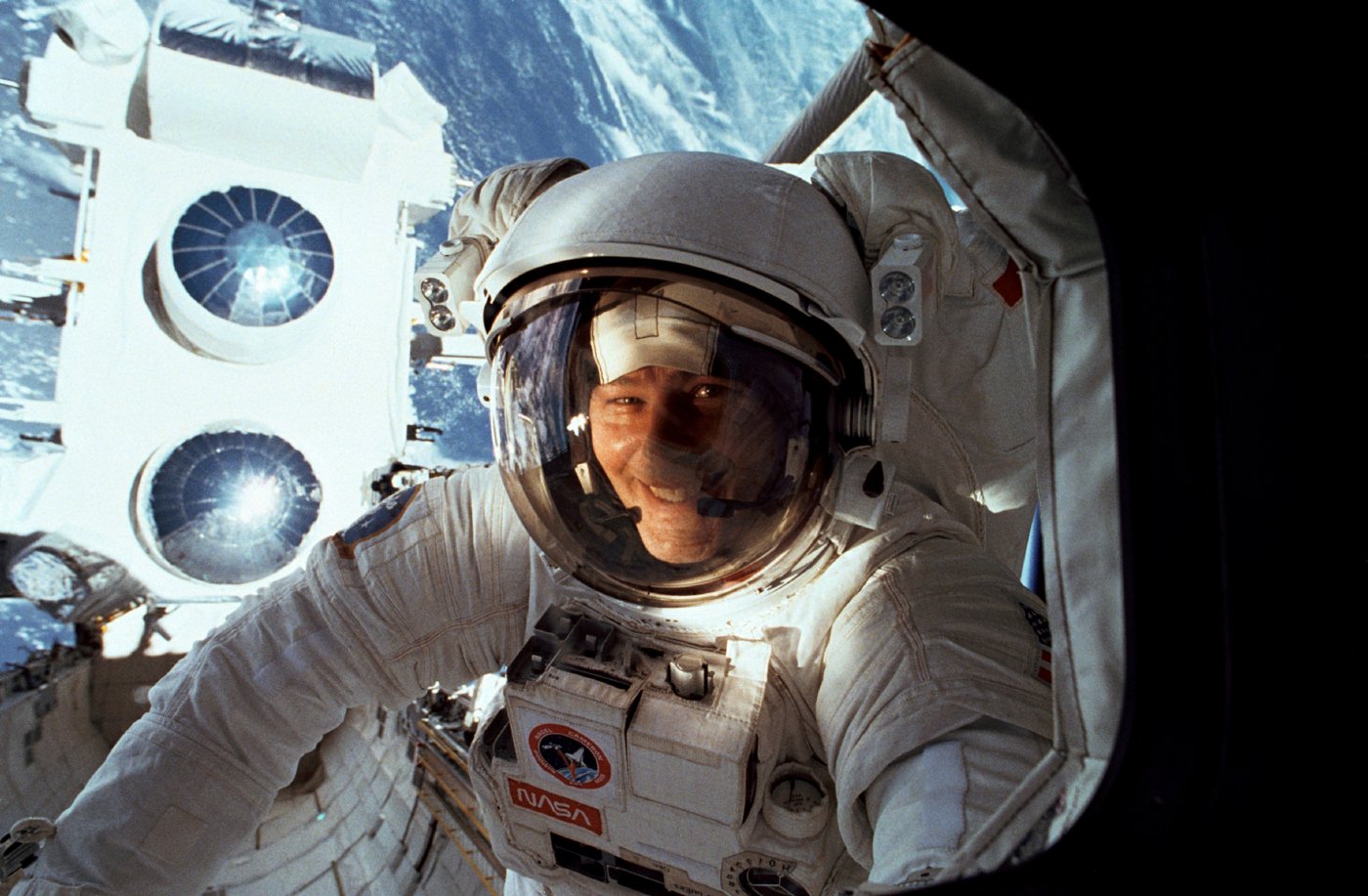
On April 8, 2002, the space shuttle Atlantis lifted off for the International Space Station with Jerry Ross aboard. NASA’s record of the mission begins with what that launch meant: Ross had become “the first human to fly in space seven times, breaking his own and other astronauts’ records of six space flights.”6
He had been born in Crown Point, Indiana, in January 1948, which made him 54 years old.3 He had been working toward that day, by his own account, since he was in the fourth grade there.1
Jerry Lynn Ross is living, and this story is told mostly in his own words. In December 2003 and January 2004 he sat for long interviews with the NASA Johnson Space Center Oral History Project in Houston, and the edited transcripts are part of NASA’s historical record.1,2 Where his memory and NASA’s official records differ in a detail, both are given.1,2,3
A scrapbook in Crown Point
Ross was born in Crown Point, Indiana, on January 20, 1948, and graduated from Crown Point High School in 1966, according to his NASA biography.3 His parents were Donald J. Ross and Phyllis E. (Dillabaugh) Ross.3
“I actually grew up during the space race,” he told the NASA interviewer, Jennifer Ross-Nazzal. He remembered watching Disney television programs about Wernher von Braun’s ideas for space stations. “I, literally, was so fascinated by it that all my family members, the bigger family of aunts and uncles and cousins, knew that I was fascinated by it,” he said, and aunts and uncles saved their Look and Life magazines with space articles and sent them to him. “So, with my mom’s help, we actually cut out the articles and made a scrapbook.”1
He was in the fourth grade, he said, when the first Sputnik went up in October 1957 and the first U.S. satellite followed in January 1958.1 Reading his scrapbook, he learned that it was mostly scientists and engineers who were making it happen. “I truly didn’t fully understand what an engineer was, but I knew that they had to use a lot of math and science,” he said. “I liked math and science, as far as I knew at that point, as a fourth grader.”1
Many of the articles came from Indiana papers, and they tended to focus on Indiana people, many of whom had gone to Purdue. “So, be an engineer, go to Purdue, get into the space program, that was the formula for me,” he said. “My mom always said that I was really a one-track kind of kid, one-track mind.”1
That summer he started working on farms. Every dollar he made driving tractors or baling hay went into a bank account for college, he said, except for a bicycle “and maybe a motorcycle or two along the way.”1
He followed every flight. “In fact, I played hooky when John Glenn launched,” he said. “My mom let me do that.”1
Purdue and the steel mill
He went to Purdue, as planned, and earned bachelor’s and master’s degrees in mechanical engineering there in 1970 and 1972.3 For four summers during college, he said, he worked at United States Steel in Gary.1
He was home in July 1969 when Apollo 11 landed on the moon, he said.1 His fiancée, Karen, was visiting, and they watched in the family living room late into the evening, waiting for Neil Armstrong to step out. “My wife-to-be was sitting on my lap,” he said. His younger sister snapped pictures of the television screen with her little camera. “I’m going, ‘That’s not going to come out.’ But they did, which was pretty amazing.”1 His biography identifies his wife as the former Karen S. Pearson, of Sheridan, Indiana.3
He joined Air Force ROTC at Purdue, he said, partly because the Air Force was the Defense Department’s main user of space. And he had noticed that NASA was planning something called a space shuttle, which would carry people who were not military test pilots.1 He was commissioned on graduation in 1970.3
“Don’t give up too easily”
The Air Force sent him to Wright-Patterson Air Force Base in Ohio to work on ramjet engines, and then, in the summer of 1975, to the Air Force Test Pilot School at Edwards Air Force Base in California, which he went through as a flight test engineer.1 His biography says he graduated from the school’s Flight Test Engineer Course in 1976.3 He graduated as the top flight test engineer in his class, he said, and went to work on the B-1 bomber, responsible for its stability and control and flight control testing.1,3
Then NASA began choosing its first new astronaut class since the Apollo era. By his recollection, it had applications from close to nine or ten thousand people.1 He was one of the 210 brought to Houston for interviews. “But I was very disappointed when I wasn’t one of the thirty-five that was ultimately selected for that class,” he said.1
“I was extremely frustrated when I was sitting there at Edwards and all my friends were boxing up and getting ready to go to Houston to become astronauts,” he said.1 So he called George Abbey, who had headed the selection board, and asked whether the board had seen something that “totally turned you off.” Abbey told him no, and that they hoped he would apply again.1
Ross told Abbey what else he was weighing: going back to the Test Pilot School to head its flight test engineer curriculum, or teaching at the Air Force Academy. Abbey suggested one more option: come to Houston as an Air Force officer, working on military payloads for the shuttle. “No promises should be expected, and none are being made here,” Ross remembered Abbey telling him. He knew it might end his Air Force flying career if NASA never picked him. He went.1 His biography records that in February 1979 the Air Force assigned him to the Payload Operations Division at Johnson Space Center as a payload officer and flight controller.3
In the years before his selection, he also got a close look at the first shuttles coming home. For the early flights, NASA flew T-38 jets alongside the orbiter on its final approach as a backup source of airspeed and altitude calls, and Ross was put on the team for the third and fourth flights. The man in the back seat, he said, helped the pilot and carried a Hasselblad camera, “and we were responsible for trying to get as many good pictures of the Orbiter as it was coming in for a landing as we could.”2
He applied again. Coming out of his second interview, he said, he thought: “Ross, you idiot. You just blew it. You might as well pack your bags and go.”1
He was in Mission Control, learning the consoles, when the call came. He recognized Abbey’s voice. Abbey asked whether he was still interested in working in the Astronaut Office. “I floated across the ponds, I think, back to Building 4,” Ross said.1 He was selected as an astronaut in May 1980.3 His children were already in Indiana for the summer, and the family called to tell them “that Daddy had been selected into the Astronaut Office.”1
Looking back on the detour, he called it “part of ‘Don’t give up too easily,’” a message he carried to schoolchildren.1 Young people, he said, “need to do well in academics; they need to set goals for themselves; they need to pursue those goals and not give up too easily.” Sometimes, years later, someone would come up to him and say: “Hey, I remember when you came and talked to my fifth-grade class.”1
“This war whoop of glee”
His first flight was STS-61B, aboard Atlantis, launched at night from Kennedy Space Center on November 26, 1985.3 He remembered the solid rocket boosters: “you really feel like your pink body’s just being shoved off the surface of the Earth by something really, really strong.” When the boosters separated, there was “this brilliant orange flash” across the windscreen.1
He and Sherwood Spring made two spacewalks to test ways of building structures in space, building a forty-five-foot truss called ACCESS and maneuvering heavy beams into place for an experiment called EASE.1,7 NASA’s mission record gives the spacewalks as five hours, 32 minutes and six hours, 38 minutes long.7
“I’ll never forget opening up the hatch and poking my head out the first time, and I literally had this very strong desire to let out this war whoop of glee and excitement,” he said. “But I figured that if I did that, they’d say, ‘Okay, Ross has finally lost it. Let’s get his butt back inside.’” Outside, he said, “I felt basically instantly at home.”1
Afterward, he said, what was most tired was not his hands but his head.1 “Literally, your mind is going a million miles an hour when you’re outside,” he said.1
Back home in Houston after landing, he was sitting in his rocking chair with his mother and father, his wife and children around him, when a neighbor knocked at the door. “The most natural thing for me to do was to push off from the arms of my chair and float over to the door and let them in,” he said. “And I caught myself trying to do that.”1
Two months later, Challenger was lost. He was at Los Alamos, New Mexico, training for a military flight that was supposed to be the first shuttle launch from Vandenberg Air Force Base in California. That flight never happened.2 In the wake of the accident, he said, all crew and flight assignments were cancelled, “so we were back to the drawing board.”2
After Challenger
His second flight, STS-27, a Department of Defense mission aboard Atlantis, launched on December 2, 1988.3,8 Going up the second time, he said, took “a little bit more guts” after a catastrophic accident. “I can remember vividly that time in our launch coming and going and thinking, ‘Well, that’s where their ride ended.’”2
“But you put that behind you very quickly and you have to concentrate on what you’re doing,” he said.2
In orbit, the crew could see damage to the heat-protecting tiles on one of the orbiter’s engine pods. On the ground they learned it was much worse: “one complete tile was missing and we had a near burn-through of the Orbiter’s skin,” he said. “In fact, that was the worst tile damage ever recorded on an Orbiter to date.”2
The antenna
In April 1991, on STS-37, Atlantis carried the Gamma Ray Observatory, a 35,000-pound satellite that his biography calls the heaviest civilian satellite ever launched by a shuttle.3 The crew had trained for contingency spacewalks but did not expect to need them.2 The solar arrays deployed. The high-gain antenna did not.2
Ross was in the pilot’s seat. The plan, he said, was to fire some thrusters to try to shake the boom loose, and then for crewmate Linda to shake the robot arm, gently, with so heavy a payload on the end of it.2 “So after about the second or third iteration of the things that we were trying in a sequence, I looked over at Steve, I took off my wedding band, and I said, ‘Steve, I’m going downstairs to get ready,’” he recalled. “It wasn’t forty-five seconds later,” he said, that the ground called and suggested sending him and Jay Apt downstairs to suit up.2
He had never been nervous about going outside before, he said, but this time he was. He did not know what was wrong with what he called “this $630 million satellite or whatever it was,” or whether it could be fixed. With its solar array already deployed, he worried, they might not be able to bring it home.2
He climbed onto the satellite and worked his way around to the antenna boom, with hydrazine fuel tanks just under his feet and knees. On the third push or so, putting in what he remembered as 45 or 50 pounds of force, he felt it start to move. “Finally, it came free and swung out about thirty or forty degrees from the stowed position,” he said. “As soon as that was done, I let out a war whoop.”2 He then slowly maneuvered the boom up into position, held it there and threw the bolt that locked it in place. “I felt that I’d probably earned my keep for that day,” he said.2
NASA’s mission record says the antenna “was finally freed and manually deployed by Ross and Apt during an unscheduled contingency space walk, the first since April 1985.”4 Ross called it a demonstration of “where the man in the loop can help a robotic system and let it go off and do some really great science.”2
Seven
He flew four more times. He was payload commander on STS-55, the German Spacelab D-2 mission, in 1993, and flew on STS-74 to the Russian space station Mir in 1995.3
In December 1998 he flew on STS-88, the first assembly mission of the International Space Station. The crew joined the U.S.-built Unity module to the Russian Zarya module, and Ross and Jim Newman made three spacewalks to attach cables, connectors and handrails.5 His biography gives the three spacewalks a total of 21 hours and 22 minutes.3
His seventh flight was STS-110 in April 2002, which installed the S0 truss on the space station. NASA records that his two spacewalks on that mission brought his total to 58 hours and 18 minutes.6 His biography says he made nine spacewalks in all and spent more than 1,393 hours in space, and that his seven flights are a world record he shares with one other NASA astronaut.3
He supported the shuttle program as an astronaut, his biography says, “from before the first launch in April 1981 to the last landing in July 2011.” He retired from NASA on his birthday, January 20, 2012.3
In Crown Point, according to his NASA biography, the school system named an elementary school in his honor.3 In May 2014 he was inducted into the Astronaut Hall of Fame.3