Treat Everything as a Problem to Be Solved
Janice Voss was born in South Bend, started working for NASA as a Purdue freshman, applied to be an astronaut four times, and flew in space five times. Near the end of her life she told Purdue’s oral historian how it had really gone.
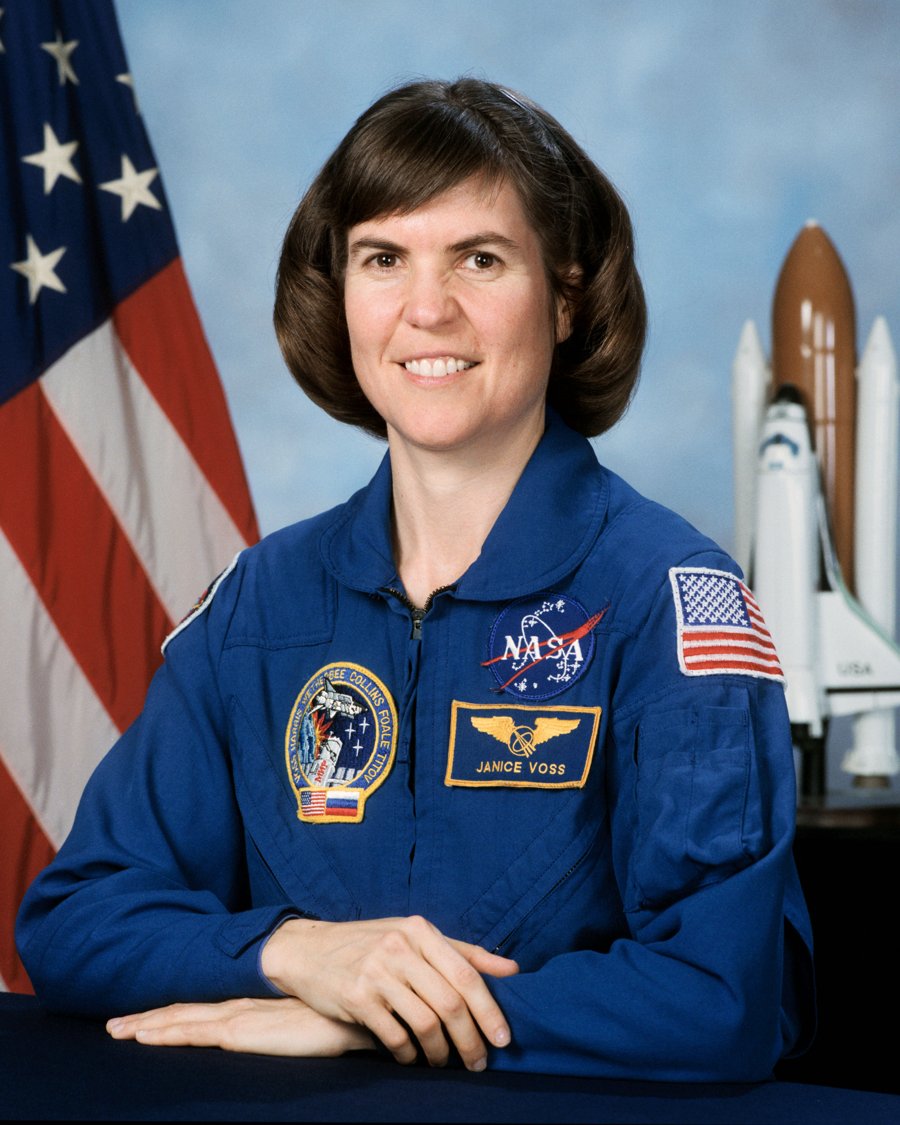
On January 12, 2011, Janice Voss sat down in Stewart Center on the Purdue University campus with Katherine Markee, the university’s oral history librarian, and talked for most of an hour about her life.1
She had flown in space five times. She had spent more than 49 days in orbit and traveled 18.8 million miles, according to her NASA biography.2 She was, NASA said later, one of only six women who had flown in space five times.3 Purdue counts her as its first woman in space.11
But what she wanted to talk about, when she talked to students, was how hard it had been to get there.
“When I talk to, especially high school or college students, about you know career paths, answer questions how to be an astronaut,” she said, people looked at her biography and wondered how anyone could do what she did.1 So she told them how it looked while she was living it.
Thirteen months later, she was dead of cancer at 55.2,10
South Bend, Rockford and DuPont
Janice Elaine Voss was born in South Bend, Indiana, on October 8, 1956.2,10 Her NASA biography put it the way astronauts’ biographies do: born in South Bend, “but considered Rockford, Illinois, to be her hometown.”2
She explained the difference to the oral historian. “So I was born in South Bend, Indiana. We moved when I was about 3 so I don’t really have any memories of South Bend,” she said.1 When NASA announced her selection as an astronaut, the press release gave her birthplace, and the South Bend newspaper called her. “So what do you remember about South Bend?” it asked. “I said well we lived on the corner,” she recalled, laughing. “They never called me again.”1
Her father had grown up in Rockford, and the family lived there from 1959 to 1967. “That’s where my accent comes from,” she said. Then a job change took them to Massachusetts.1 She graduated from Minnechaug Regional High School in Wilbraham, Massachusetts, in 1972.2
Indiana stayed in the family. Her parents, she said, retired to a family farm in southern Indiana, at DuPont, where her mother’s father had been born. “Of course I’ve known it since I was small,” she said. She spent summer vacations, Christmases and Thanksgivings there.1 Her NASA biographies list her parents, Dr. and Mrs. James R. Voss, as living in Dupont, Indiana.2,5
She learned to read before kindergarten by listening while her oldest sister learned. A kindergarten teacher saw it and arranged for her to skip ahead. She later did high school in three years.1
Science fiction, she said, was what first drew her to space. “I picked up Madeleine L’Engle’s, A Wrinkle in Time at the public library in 6th grade and it got me hooked on science fiction from there to the space program,” she told Purdue.1 (Her mother told The New York Times in 2012 that Janice was 6 when she found the book.)10
Purdue
In 1972, she said, the aerospace industry was “crashing,” and everyone was saying there would be no jobs. “I wanted to be in the space program, you know they weren’t even sure they gonna have a space program when I graduate, right.”1
So she applied only to schools where she would not have to pick a major right away. Purdue, with its common first-year engineering program, was one of four, and she got into all four. Purdue, she said, “was head and shoulders above the rest” in how friendly and helpful its materials were.1 She also knew that Purdue had produced more civilian astronauts than any other university. That was not the deciding factor, she said, “but it was a nice bonus, right to have classes in Grissom Hall.”1
She lived in Meredith Hall her first semester. In a freshman engineering session someone described the co-op program, in which students alternate semesters of work and school, and mentioned that one of the employers was NASA. “And I went what?” she said.1
There was one opening, at Johnson Space Center in Houston, starting in January of her freshman year. She had enough credits to qualify, and took it.1 NASA’s biography records that she was a co-op at Johnson from 1973 to 1975, doing computer simulations in the Engineering and Development Directorate.2 The New York Times later wrote that she was 16 and a Purdue freshman when she first worked for NASA.10
Her first assignment was with a group that worked on pyrotechnics for parachutes, and for half a semester they had nothing for her to do. She complained to her father. “He said time is never wasted. Find something productive,” she recalled.1 The co-op office moved her to the hybrid computation and simulation branch, where she spent the rest of her co-op terms, working on both analog and digital computers.1
Because she alternated between Houston and campus, she never spent two semesters in a row at Purdue. She received her bachelor’s degree in engineering science in 1975.1,2 Engineering science, she said, was being folded into another program while she was in it: “I was in the last graduating class of engineering sciences.”1
Plan B
What followed, by her account, was a run of bad luck that she later turned into a lesson for students.1
Her first round of graduate applications was turned down; it turned out she had applied for a January start through admissions offices that only handled fall admissions. Her boss at NASA, an MIT graduate, called a professor he knew, and MIT admitted her.1 The program she entered was canceled the semester she arrived. Her master’s thesis adviser died of a heart attack while she was halfway through.1 She earned a master’s degree in electrical engineering from MIT in 1977.2
She went back to Johnson Space Center and taught entry guidance and navigation to shuttle crews.2,3 She applied to be an astronaut. She was not selected.1
“And about this time I’m just thinking you know Janice you really might not get to be an astronaut, you probably should really think about plan B,” she said.1 She spent a year in astrophysics at Rice University, then went back to MIT, where one research contract was canceled, an adviser died, another left, and the chairman of her doctoral committee did not get tenure and left six months before she finished.1 She received her doctorate in aeronautics and astronautics from MIT in 1987 and went to work for Orbital Sciences Corporation.2
“So I tell people yeah, you look at my bio,” she said, and people think she must be remarkably flexible. “At the time I was barely hanging on by the skin of my teeth, right. But the lesson to learn is treat everything as a problem to be solved, not as a disaster to be survived.”1
She applied to the astronaut program four times. “That’s another lesson I pass on, never give up, and never surrender,” she said. “You can change your mind, there’s nothing wrong with changing your mind but don’t do it from a position of surrender.”1
NASA selected her in January 1990. She became an astronaut in July 1991.2
“I’m certainly excited today”
Her first flight was STS-57, aboard Endeavour, which launched on June 21, 1993.4 It was the first flight of Spacehab, a commercially developed pressurized laboratory carried in the shuttle’s payload bay, and the crew also retrieved the European Retrievable Carrier, a satellite left in orbit by an earlier mission.4
Before the launch, she told the Purdue interviewer, the crew flew to Kennedy Space Center and each member made a short speech to thank the workers there. As the most junior member she spoke last, and everything she had planned to say had already been said. Her parents were in the crowd.1
When she was selected as an astronaut, her family had asked whether she had jumped up and down in the elevator. In high school she had once jumped around a television stage after her team won a quiz-show semifinal, and her parents still teased her about it. So, at the microphone, she jumped. “I said my family knows when I’m excited I just jump all over the place and I’m certainly excited today,” she recalled.1
A photographer caught her in midair. She was afraid she had embarrassed the crew. Instead, she said, the pilot, Brian Duffy, put his arm around her and said: “Janice we all wish we could do that and none of us ever had the guts.”1
During the satellite retrieval, she said, she was alone in the Spacehab module, watching through its overhead window with a hand-held laser as the satellite came in. “I’ve never done a spacewalk but I think it gave me much the same feeling,” she said. “It felt like I was kind of in my own little space craft.”1
Bad weather kept the shuttle from landing on schedule. With the experiments shut down, she took out the book she had brought along, Isaac Asimov’s “Foundation,” went up to the flight deck, and read it by earthlight. “That was just a really great closing of the circle,” she said.1 On a later flight she carried a copy of “A Wrinkle in Time” that Madeleine L’Engle had sent her, and returned it to the author.1
Mir, and a flight flown twice
In February 1995 she flew on Discovery on STS-63, the first flight of a female shuttle pilot and the first approach and flyaround of the Russian space station Mir by a shuttle.5,12 The crew included a Russian cosmonaut. In the Purdue interview she told how, on an open amateur radio call, a ham operator on the West Coast heard a Russian voice using a Mir call sign and could not be convinced that he was talking to the space shuttle.1
In April 1997 she was payload commander on STS-83, aboard Columbia, carrying the Microgravity Science Laboratory. One of the shuttle’s three fuel cells began showing an upward trend in voltage difference soon after launch, and the Mission Management Team ordered the flight to end early. NASA records that it was only the third time a shuttle mission had been cut short.6 The crew was back on the ground after less than four days.6
Three months later, the same crew flew the same laboratory again. STS-94 lifted off on July 1, 1997, and NASA records it as “the first reflight of same vehicle, crew and payloads.”7 The crew worked in two shifts around the clock for nearly 16 days. The combustion experiments, NASA reported, produced the weakest flames, as low as one watt, ever burned in laboratory conditions, and more than 200 fires or combustion runs were completed, though only 144 had been scheduled.7
Her last flight was STS-99, aboard Endeavour, in February 2000, the Shuttle Radar Topography Mission. NASA’s press kit described her as payload commander, with “overall responsibility for the operation of the SRTM systems during the flight.”8,2 The mission mapped more than 47 million square miles of the Earth’s land surface.2,3
She thought it was the most important thing she had done. The flight produced a single, consistent three-dimensional map of the Earth’s land between 60 degrees south and 57 degrees north, she said, in place of maps stitched together from different sources with “artificial cliffs” where they met. “In terms of value to the planet, that mission is probably the single most important space mission we will ever fly in terms of a single mission,” she said.1
Kepler, and back to Houston
After five flights, she was told it would be at least four years before she could fly again.1 From 2004 to 2007 she was science director for the Kepler spacecraft at NASA’s Ames Research Center, the mission that searched for Earth-size planets around other stars.2,3 The year she had spent studying astrophysics at Rice, she said, was what got her the job.1
In 2007 she returned to the astronaut office in Houston, she said, “with no expectation of flying.”1 NASA said that at the time of her death she was the payloads lead of the Astronaut Office’s Station Branch.3 “During the last few years, Janice continued to lead our office’s efforts to provide the best possible procedures to crews operating experiments on the station today,” said Peggy Whitson, chief of the Astronaut Office.3
She told the Purdue interviewer that whenever she came back to campus she tried to speak to the women in engineering seminar for first-year students, and to tell them the story of her “tortuous college career.” Students, she said, assumed that because she had wanted to be an astronaut since grade school she “just laid out her path and she cruised. But it wasn’t like that at all.”1
S.S. Janice Voss
In 2014, a commercial cargo ship built by Orbital Sciences, the company where she had worked after finishing her doctorate, delivered supplies to the International Space Station. NASA’s media advisory for its departure called it “Orbital Sciences Corporation’s Cygnus cargo spacecraft, the SS Janice Voss.”9,2 It delivered almost three tons of supplies and scientific experiments to the station’s crew, and was scheduled to leave the station on August 15.9
How she died
Janice Voss died on February 6, 2012, of cancer.2,3 NASA announced that she had “passed away from cancer overnight,” and her NASA biography says she died “after battling cancer.”3,2 The New York Times reported that she died on a Monday at a hospital in Scottsdale, Arizona, that she was 55 and lived in Houston, and that her mother had given the cause as cancer.10 The sources read for this story do not say what kind of cancer it was.