The Vault
When James Whitcomb Riley died in July 1916, Greenfield and Indianapolis both wanted him. His family put the decision off. For more than a year the most popular poet in America lay in a flower-lined vault at Crown Hill, until the cemetery offered him its highest hill.
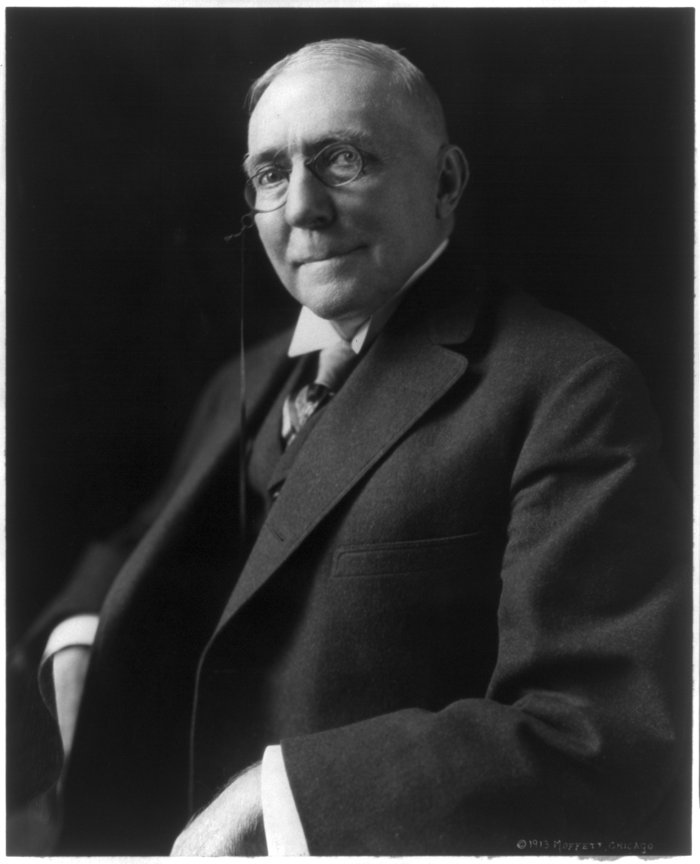
The state historical marker outside the house on West Main Street in Greenfield calls James Whitcomb Riley an “editor, author, poet, lecturer and entertainer,” and “one of the best known Hoosiers of all time.” It notes that he “first wrote under the name of ‘Benj. F. Johnson of Boone’ and was famous for his use of Hoosier dialect.”1 The marker gives his dates as Oct. 7, 1849, to July 22, 1916.1
Those dates were not settled while he lived. On the Monday after his death, a wire report printed in Iowa said the exact date of his birth “was not generally known until after his death, because the poet for some unknown reason was sensitive on the matter.”2 Other papers that same week still printed the wrong year. One West Virginia weekly said that Riley “evaded inquiries as to the date of his birth, but the most accurate information available indicates that he was born in 1853 at Greenfield.”3 A Mississippi weekly also gave 1853.4
The question of where he was born was easy. The question of where he would be buried took more than a year. This story follows that year, using newspapers from the time and the records of the cemetery that finally received him.
Saturday night on Lockerbie Street
Riley died at his home on Lockerbie Street in Indianapolis “at 10:50 o’clock Saturday night, soon after he had passed into a peaceful sleep,” according to the wire report. It said death “was due to paralysis.” He had suffered “a violent stroke” at 7:30 that morning and seemed to recover. A stroke in 1910 had disabled his whole right side.2
The same dispatch opened the argument that this story is about. “Hardly had word of Riley’s death been received before Indianapolis and Greenfield, his birthplace on the Brandywine, began a rivalry for the body,” it reported. “There is a vacant place in the Riley plot at Park cemetery at Greenfield, and Greenfield claims that Riley wished to be buried there.” Indianapolis, it said, “asserts that public reasons favor his burial here.” The board of directors of “a large cemetery” was expected to vote that day to offer, on behalf of the city, “one of the most beautiful burial sites for the Riley grave.”2
The Decatur Daily Democrat carried the same plans that Monday. Riley’s funeral would be “tomorrow and will be private,” and “the body will be placed for the present in a vault at Crown Hill cemetery here. Relatives said the body probably would be finally interred at Crown Hill, although Greenfield, his birthplace, is bidding for the honor.”5
The Richmond Palladium printed a version that made the choice sound finished. “The original intention was to bury him in Greenfield his birthplace and boyhood home,” it said, “but the plan was changed because it was thought his grave should be where it might be visited by the public.”6 The same story described the street where he died. “Quiet Lockerbie street, where the poet lived during the height of his literary fame, was never so quiet as today,” the Palladium wrote. Children “who used to run and shout and play with Riley at his home, gazed at the big brick house without uttering a word.”6
So by Monday afternoon, Indiana readers had three accounts. In one, the two cities were rivals. In another, Crown Hill was “probably” the choice. In the third, the change of plan had already been made. Hoosier First found no report from that week in which the family itself settled the question.
The Statehouse and the delegation
On Monday afternoon and evening, July 24, Riley’s body lay in state in the rotunda of the State Capitol. The wire report gave the hours as 3 p.m. to 9 p.m.2 A West Virginia weekly said the hours had been “fixed especially with the view of providing a time when working people and children, accompanied by parents, might view the body.”3
How many came depends on the source. A wire report printed in Birmingham, Ala., said that “policemen on duty at the statehouse estimated tonight that at least 50,000 persons passed through the corridors and took a farewell look at the poet.”7 The Theocrat, a weekly in Zion City, Ill., repeated the same figure.8 The Crown Hill Foundation’s present-day biography says that “more than 35,000 people came to pay their respects.”9 Hoosier First reports both numbers. The 1916 figure was a police estimate made that night.
While the line moved through the Statehouse, Greenfield made its case in person. A dispatch in the Barre Daily Times of Vermont on July 25 reported that “a large delegation from Greenfield, Ind., Riley boyhood home,” had called at the Riley home the night before. Its purpose, the paper said, was to persuade the family to have the body buried in Greenfield.10
There was also a question of where the body would wait. The Bisbee Daily Review in Arizona printed a Monday night wire account. The burial, it said, “will be either in Indianapolis or Greenfield, Ind., his boyhood home.” Then it added a promise: “The body will not be placed in a cheerless and bleak vault.” The committee that had arranged “the Riley Day celebration October 7, 1915, has decided to decorate the vault with flowers and rugs.” Local florists, it said, were “practically all” sold out.11
Riley Day
That committee had a recent history. In September 1915, the Richmond Palladium reported that Gov. Samuel M. Ralston had issued a proclamation calling on the people of Indiana to honor Riley.12 On Oct. 7, his birthday, schools across the state held programs. In Richmond, the Palladium reported, there were “programs of music, recitations of Riley’s poems and addresses in the public schools.” A speaker at the high school “urged the students to visit Greenfield, the birthplace of Riley and see for themselves the scenes described in the poems.”13
The next day, the Palladium printed a brief item from Rochester, Ind. The people there had sent the poet a birthday greeting. “At the end of the greeting were the words: ‘Take keer of yourself.’”14 A wire summary printed after his death said Riley Day had been “observed by a banquet in Indianapolis, and in schools of the country attended by more than 1,000,000 children.”4
Riley was alive for that celebration and died nine months later.1 The volunteers who had organized his birthday then set out to decorate his temporary tomb.11
The funeral was private; the vault was not
The funeral was held on Tuesday afternoon, July 25, at the Lockerbie Street house. The Daily Tribune of Terre Haute ran the story under the headline “Hoosier Poet’s Body Is Placed in Vault.” It said the “simple services were attended by relatives, and a few of his most intimate friends only.”15
The Rev. Joseph A. Milburn of Sewanee, Tenn., led the service. He was a former pastor of the Second Presbyterian Church in Indianapolis and “a close friend of the poet for many years.” He was assisted by the Rev. Frederick E. Taylor, pastor of the First Baptist Church.15
“The funeral was private,” the Tribune wrote, “but the placing of the body in a vault in Crown Hill cemetery was public. Large crowds assembled near the vault to see the last ceremonies.”15 The body “was placed in the vault pending arrangements for its final disposition.” The vault “was decorated with flowers of brilliant colors,” chosen as the ones the poet liked best. “Beautiful rugs were spread on the floor. A short prayer at the cemetery concluded the services.”15
The reports do not agree on the hour. The Birmingham account published Monday night gave 2:30 p.m. as the planned time.7 The Barre Daily Times reported on Tuesday that the services were held “at 2:10 o’clock this afternoon.”10 Hoosier First could not determine which was correct.
Several reports used the same image for where the body now rested. The Tulsa Daily World ran the headline “Riley Lies Among Flowers He Loved.” Its dispatch said the body “rests tonight in a flower-lined vault in the little chapel at Crown Hill cemetery.”16 The Theocrat called it “a receiving vault.”8 A receiving vault was a holding place, not a grave. Another dispatch called it the poet’s “temporary resting place.”17
The papers said plainly that nothing had been decided. A dispatch in the Birmingham Age-Herald on July 26 said: “The final resting place of the body had not been determined tonight, it was said, and no decision may be reached for sometime.”18 On July 27, the Barre Daily Times called the vault the poet’s “temporary resting place.” It reported that “friends of the poet have already started plans to erect a mausoleum.”17
The West Virginia weekly printed a version that sounded settled: “It was agreed that the burial be in Crown Hill cemetery, near here, relatives feeling that Mr. Riley should be buried where the public might easily visit his grave. First plans were for burial near Greenfield, Ind., the birthplace of the poet, but the feeling that Mr. Riley belonged to the people led to a reconsideration.”3
Even this account names only a cemetery, not a grave. Riley’s body stayed in the vault.
About 15 months
The Crown Hill Foundation, which preserves the cemetery’s history, gives the clearest account of what followed. After his funeral, it says, Riley “remained in the Gothic Vault (known today as the Gothic Chapel) for over a year as his family determined where his final resting place should be — Indianapolis or his childhood town of Greenfield.” Then “after Crown Hill Cemetery offered the ‘Crown’ to the family, they decided on Indianapolis.”9
The “Crown” is the summit of the cemetery. The Foundation says Riley “is buried on the highest hill in Marion County.”9
Hoosier First found one newspaper account from the time of that decision. On Oct. 31, 1917, the Arizona Republican in Phoenix reprinted a piece from the Indianapolis News under the headline “Riley’s Tomb to Be Built Upon a Hill.” It began: “Almost coincident with the celebration of the birthday of James Whitcomb Riley, October 7, a worthy resting place for the body of the poet has just been chosen at Crown Hill cemetery.”19
“The site is a beautiful knoll at the summit of the burial ground, from which there is a panoramic view to every sector of the distant horizon,” the piece continued. It said the setting would allow “a permanent monument to the poet which in every way will measure up to what the people of Indianapolis and Indiana would like to see.” It ended with a forecast: “In the long decades ahead the people will turn to Riley’s grave as a shrine.”19
The 1917 reprint and the Foundation’s account place the end of the wait in the same month. The Foundation says Riley “was interred on the ‘Crown’ in October of 1917,” after “additional time then was needed to build his monument.”9 The News piece, written that same October, says only that the site “has just been chosen” and speaks of the tomb in the future tense.19 Hoosier First could not find a 1917 newspaper report of the burial itself. Neither source says whether the body went into the ground before the monument was finished. The October 1917 date in this story rests on Crown Hill’s record.
What the record does show is the length of the wait. Riley entered the receiving vault on July 25, 1916.15 He was still there on the first anniversary of his death. By Crown Hill’s account, he left it for the hilltop in October 1917, about 15 months later.9
What the hill became
By the early 1920s, the hilltop was where Indianapolis honored Riley. On Oct. 6, 1921, the Indianapolis Times printed the program for his birthday under the headline “Riley Birthday to Be Observed.” The Riley Memorial Association would visit the Lockerbie Street home, and “Indianapolis Elks will place wreath on tomb of James Whitcomb Riley at Crown Hill Cemetery.” At another ceremony, the first tree would be planted “on ground to be used for James Whitcomb Riley Hospital for Children.”20
The next day, the Times reported on the events under the headline “Wreath Placed on Riley’s Tomb.” There were “programs in every public school in Indianapolis and six formal celebrations at different places in the city.” The Elks “placed a wreath on his grave at Crown Hill.” Schoolchildren took part in planting the first tree for the children’s hospital, and the report lists Gov. Warren T. McCray among the speakers.21 The program announced the day before had said the tree would be planted by McCray.20
In February 1923, a correspondent named L. V. Schneider wrote from Indianapolis for the Richmond Palladium. He described the grave the Indianapolis News had predicted in 1917. “On the highest knoll in Crown Hill cemetery here stands the tomb of James Whitcomb Riley,” he wrote. “A marble slab marks the grave and rising above are ten simple columns with Ionic capitals.”22
Schneider then turned to a second memorial. Construction was “well under way” on the first unit of the James Whitcomb Riley Hospital for Children, he wrote, “being built here as a state memorial to the poet and for the care and treatment of crippled and sick Indiana children.” He called it “a $2,000,000 institution, the gift of the people of the state to the state, in memory of the state’s most beloved poet.”22
The argument, reread
The newspaper record does not show a bitter fight between Greenfield and Indianapolis. It shows a family under pressure from two directions.
Greenfield had the family plot, with a “vacant place” in it, and the claim that Riley wanted to rest there.2 It sent a delegation to the house on the night he lay in state.10 And it had his old neighborhoods. Only months earlier, a speaker in Richmond had told students to go there and see the places in his poems.13
Indianapolis had the crowds. Tens of thousands had filed through the Statehouse, by any count.7,9 It also had the case that newspapers repeated all that week: that Riley’s grave “should be where it might be visited by the public,” and that “Mr. Riley belonged to the people.”6,3 In the end, the cemetery made an offer Greenfield could not match. According to Crown Hill, it offered the hill itself.9
The year in the vault is easy to lose in the larger story of the Hoosier Poet. It is missing from the Greenfield marker, which has room for only one sentence of biography.1 The cemetery that kept him does record it.9 So do the newspapers. They show a funeral that was private, a vault that was public, a committee that decorated it with flowers and rugs, and a family that decided slowly.
Crown Hill’s list of notable burials now places Riley in Lot 1, Section 61. Its one-line note on him ends with the words “buried on Crown.”23 The Indianapolis News predicted in 1917 that people would “turn to Riley’s grave as a shrine.”19
How he died
James Whitcomb Riley died at his home on Lockerbie Street in Indianapolis at 10:50 p.m. on Saturday, July 22, 1916.1,2 The wire report said that his death “was due to paralysis.”2
It was not his first stroke. One in 1910 had disabled his whole right side. On the morning of the day he died, at 7:30, he suffered “a violent stroke” and seemed to rally. That night, the report said, he died “soon after he had passed into a peaceful sleep.”2 Hoosier First did not see a death certificate.