A Note Belonged on a Musical Staff
Hoagy Carmichael was supposed to be a lawyer. He learned piano by ear from his mother in Bloomington, played his way through Indiana University, and wrote ‘Stardust,’ one of the most recorded songs of the twentieth century.
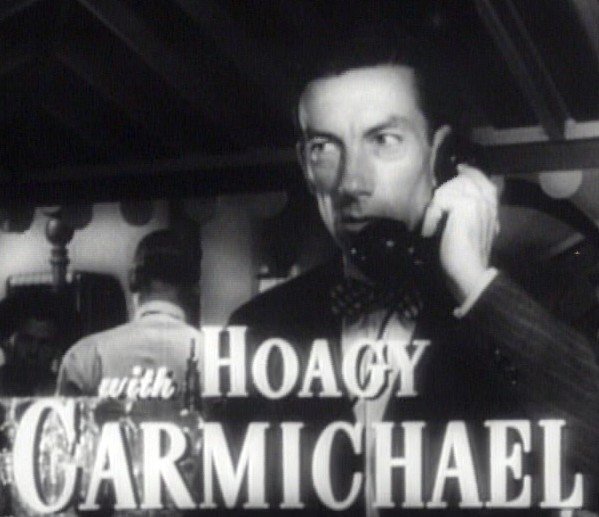
Years later, a BBC interviewer asked Hoagy Carmichael where “Stardust” came from.2
“Well, I got the idea just walking across the campus one night, my university campus where I went to school,” he answered, as quoted in an essay published by the Library of Congress. “I’d just left the college hangout called the Book Nook, and I started whistling, and I whistled this opening strain of ‘Stardust,’ and I knew that I had something very strange and different.”2
The Book Nook stood at 114 South Indiana Avenue in Bloomington. The Indiana Historical Bureau’s marker in front of the building, installed in 2007 with the City of Bloomington, says: “Hoagy wrote that he composed ‘Stardust’ in part on the piano of the Book Nook located here.”1
The song has been recorded more than 1,500 times, according to the Library of Congress essay.2 The man who wrote it had a law degree and, by his own account, not much use for it.11
This story draws on the Indiana Historical Bureau marker and its notes, a Library of Congress essay on his first recording of “Stardust,” Indiana newspapers from the 1920s and 1930s, and the wire reports published when he died.1,2 Where those sources disagree, as they do on how and when “Stardust” first reached the public, both versions are given.2,11
A ragtime mother
Hoagland Howard Carmichael was born in Bloomington on November 22, 1899, to Howard Clyde and Lida Mary Carmichael, according to the historical bureau’s notes for the marker.1
He learned to play the piano by ear from his mother, “whose ragtime playing was the delight of the Bloomington, Indiana, neighborhood where he was born,” a profile in The Gary American reported in 1938.10 The wire service reports at his death said he never took formal piano lessons.11,12
The bureau’s notes record that, while the family lived in Indianapolis, he met a Black pianist named Reggie DuValle, who, Carmichael later recalled, helped him gain his first conception of harmony and jazz.1
The Book Nook crowd
He began attending Indiana University in 1920 and graduated with a law degree in 1926, the marker says.1
Carmichael was “a ‘hot piano player’ and bandleader during his college years,” Richard Falco writes in the Library of Congress essay. He was a fan and friend of the cornetist Bix Beiderbecke and his band, the Wolverines, and booked them on the campus.2 Carmichael, the essay adds, “proudly acknowledged the enormous influence of Louis Armstrong,” whom he met through Beiderbecke in 1922.2
The Indianapolis Times, in a 1936 story about another Indiana University student of those years, Ernie Pyle, described the scene at the Book Nook as a gathering of “Bohemian students who have since become well-known for their writings.” “Hoagy Carmichael, nationally acclaimed song-writer, was in the Book Nook crowd,” the paper said, and young Pyle, “amid the thick smoke and unorthodox ways of Book Nook Bohemians,” talked, read and dreamed of strange places.7
He played his way through law school with a three-piece orchestra, according to The Gary American.10 By way of diversion, he composed “Riverboat Shuffle.” The Wolverines liked it, learned it from him and recorded it; a New York publisher heard the record and printed the music. “It was Hoagy’s first published work,” the paper said.10 The New York Times, in its 1981 obituary, said “Riverboat Shuffle” was his first song to be recorded and that he had written it in 1922 for Beiderbecke.12
Then Paul Whiteman picked up his “Washboard Blues,” The Gary American reported, “but even that distinction did not impress Hoagy with his aptness in music. His mind was on the law.”10
When he left school, the band went on without him. In 1935 The Indianapolis Times reported that Amos Otstot, a pianist, had taken over the band at Indiana University; in the paper’s words, Otstot “took over the direction of Hoagy Carmichael’s orchestra after the latter’s graduation.”6
“I wasn’t a good lawyer”
After law school he went to Palm Beach, Florida, in 1926, during the real estate boom, to start a law career.11,12
“I figured there ought to be work for a good lawyer there because of all that selling and reselling going on,” he recalled in an interview years later, as quoted by United Press International. “There probably was too – only I wasn’t a good lawyer. A note to me was something that belonged on a musical staff.”11
Clients failed to materialize, The Gary American said.10 The 1981 wire obituaries say he went to New York’s Tin Pan Alley to try songwriting, failed there too, temporarily, and returned to Bloomington, where he joined the Jean Goldkette band, playing piano, arranging and getting some of his own tunes played.11,12 The Gary American’s 1938 account puts the steps in a different order, with a job in a New York bank before Florida and a period back in Indiana, wavering between law and music, before he joined Goldkette’s orchestra.10
October 31, 1927
On October 31, 1927, under the band name “Hoagy Carmichael and His Pals,” he recorded “Star Dust” at the Gennett Recording Studio in Richmond, Indiana, a subsidiary of the Starr Piano Company.2
Gennett was “a very popular studio with ‘hot’ musicians of the day,” Falco writes, including the New Orleans Rhythm Kings, Jelly Roll Morton, King Oliver, the Wolverines and Beiderbecke. Its board-paneled room was hung with draperies for acoustic treatment. Earlier in 1927 the studio had begun using a new electric recording technique under license from RCA Photophone, and the original pressing of “Star Dust” carries Gennett’s black “New Electrobeam” label.2
Carmichael played piano with members of the Emil Seidel Orchestra. They played it at a medium tempo, about 132 beats per minute. “Most later recordings present ‘Stardust’ at a ballad tempo,” the essay notes.2 The essay says he was 28 years old when he composed it.2
“By most accounts, Carmichaels’s 1927 recording was not very popular,” Falco writes.2
Hoagy on the radio
He was back in Indianapolis the next year with his own band. In the fall of 1928, The Indianapolis Times radio listings for station WFBM carried, in listing after listing, “Hoagy Carmichael and band from Columbia Club.”3 A Times radio column that October explained that WFBM was broadcasting dance orchestras four nights a week, including “the Columbia Club orchestras headed respectively by Hoagy Carmichael and Charlie Davis.”4
The 1981 wire reports put it more simply: he formed his own band in 1928 and featured his own songs, which “soon caught the public’s fancy and gave him a glimmering of success as a composer.”11,12
“Still, ‘Star Dust’ just plain gathered dust with nobody anxious to record it,” UPI wrote.11
“The studio gates stood solid”
New York’s Mills Music published the song as an upbeat piano solo in January 1929 and renamed it “Stardust.” The company’s staff lyricist, Mitchell Parish, wrote lyrics, published in May 1929.2
That same year Carmichael tried Hollywood. “Though everything else crashed that year, the studio gates stood solid,” he recalled later, in a quotation carried by UPI. “I ended up hitchiking a ride back east with the Paul Whiteman orchestra. A good-natured kid singing with the band shared his upper berth with me – Bing Crosby.”11
Back in New York, UPI reported, he organized another band and pushed his own songs.11 The big break, by every account, was the orchestra of Isham Jones. The Library of Congress essay says the first hit instrumental version of “Stardust” was recorded by Isham Jones in 1930, arranged by Victor Young and played as a ballad.2 In 1931, Louis Armstrong, Jack Teagarden and Bing Crosby all recorded it, Crosby’s being the first vocal version to include both the verse and the chorus.2 The bandleader Artie Shaw claimed that his 1940 version included “one of the first string sections used by a jazz group and [it] sold 16 million copies.”2 The essay also quotes the poet Robert Pinsky, whom it identifies as U.S. poet laureate, on Parish’s lyric: “It’s a beautifully written piece of work, just a terrific piece of work.”2
Here the 1981 wire obituaries and the Library of Congress part ways. UPI and the UPI obituary in The New York Times said “Stardust” was not recorded at all until 1930, and that Isham Jones made the first recording.11,12 The Library of Congress essay dates his own first recording to October 31, 1927, at Gennett in Richmond, and that recording was added to the National Recording Registry in 2004.2
The obituaries also disagreed with each other about where he wrote it. UPI’s first report and the Times said he scribbled it on the front pages of a law book while waiting for business in Florida.11,12 UPI’s second-day story noted that “according to one autobiography,” he wrote it in a campus hangout in Bloomington after whistling the tune, “while thinking of his girl in New York,” and that “other references have him writing the tune in a law book in Florida.”13 His own account to the BBC, and the historical bureau’s marker, place it in Bloomington.1,2
Home-state favorite
By 1935 Indiana had claimed the song. On October 10 that year The Indianapolis Times ran a short item under the headline “Dancers Prefer Hoosier Music.” Rudy Bundy, the bandleader at the Indiana Roof Ballroom, had polled his dancers for their ten favorite songs. “No. 1 on the list is ‘Stardust,’ by Hoagy Carmichael, Hoosier song writer,” the paper reported.5
A 1938 profile of him in The Gary American made the point of his whole career in one line. Hoagland Carmichael the attorney and Hoagy Carmichael the composer were the same man, it said: “Chief difference in the extremes of his dual personality is that the lawyer was a dud—the composer a top-ranking success.”10
“Honeymoon? What for?”
In March 1936 his family in Indianapolis learned from the radio that he was getting married. “All the Carmichaels know about Hoagy’s marriage plans is what they hear from Walter Winchell, they admitted today when pressed for details,” The Indianapolis Times reported on March 3.8
His sister Martha, who lived with the family on Graceland Avenue, told the paper: “If you know anything about Hoagy, you know it’s difficult to say what he will do. He lets nobody interfere with what he wants to do.”8
He married Ruth Meinardi in New York. A United Press story in the Times on March 16 reported that the ceremony was at the Fifth Avenue Presbyterian Church, where the bride’s late father had been pastor, and that afterward the couple rode a hansom cab to his home for the reception.9 (The March 3 Times story described the bride as “formerly of Warsaw, Ind.”; the United Press story called her “the comely Ruth Meinardi of Chicago.”)8,9
“Honeymoon? What for?” he told the reporter. “We’ve got to rest up from the wedding reception. You know, we had a lot of Indiana people here—people I used to go to school with, and they sure went to town.”9
“When we got there, my mother—her name’s Lida—sat down at the piano and played ‘Maple Leaf Rag,’ which she used to play at dances 30 years ago,” he said. Among the guests, the wire service reported, was the composer George Gershwin.9
Hollywood after all
The studios that had shut him out in 1929 later came asking, UPI wrote, “for his compositions and eventually his acting talents.”11
He wrote “Lazybones” with Johnny Mercer, Carmichael writing the music and Mercer the lyrics, in less than half an hour, according to the wire reports.11,12 Among his other songs were “Georgia on My Mind,” “Rockin’ Chair,” “Heart and Soul,” “Skylark,” “The Nearness of You,” “Two Sleepy People” and “I Get Along Without You Very Well.”1,12
He appeared in films including “To Have and Have Not,” “Johnny Angel,” “Young Man With a Horn” and “The Best Years of Our Lives,” usually, UPI said, at a piano.11,13 In “Canyon Passage” he wore a top hat, rode a mule and sang his own “Ole Buttermilk Sky,” which was nominated for an Academy Award in 1946.1,11 He won the Academy Award in 1951 for “In the Cool, Cool, Cool of the Evening,” from “Here Comes the Groom.”1
He was inducted into the Songwriters Hall of Fame in 1971.1 The Times reported that he and Ruth Meinardi divorced in 1955, and that in 1977 he married the actress Wanda McKay.12 In his last years he divided his time between an apartment on Sunset Boulevard and a home in Palm Springs, “playing golf whenever possible.”11,12
After his death, according to the Library of Congress essay, his family gave his archives and memorabilia to Indiana University; the Hoagy Carmichael Room opened in 1986. His 1927 recording of “Star Dust” entered the Grammy Hall of Fame in 1995 and the National Recording Registry in 2004.2
How Hoagy Carmichael died
Hoagy Carmichael died on Sunday, December 27, 1981, at Eisenhower Medical Center in California. The wire reports were datelined Rancho Mirage, and UPI described his home as being in that Southern California desert resort. He was 82.11,12,13
United Press International reported that he died of a heart attack shortly after arriving at the medical center. The hospital’s nursing supervisor, Helen Richard, said he died at 10:22 a.m. “as the result of cardiac problems.”11,12 UPI’s follow-up story the next day said he had suffered the heart attack at his home.13 The published reports give no further medical detail.11,12,13
A hospital spokesman said his body would be shipped to the Allen Funeral Home in Bloomington, for burial “near his parents in Rose Hill Cemetery,” UPI reported.13 The marker on Indiana Avenue states it simply: “Died on December 27, 1981 in California; buried in Bloomington.”1
The Monroe County History Center, in a story on the site Discover Indiana, records that a memorial service was held on January 4, 1982, at the university’s Musical Arts Center, and that a soprano, Sylvia McNair, sang a single chorus of “Star Dust.”14