Two Hatches
Gus Grissom of Mitchell flew in space twice and died on the launch pad before a third flight. His own written report, the newspapers of 1961 and the Apollo 204 Review Board tell the story in more detail than the legend does.
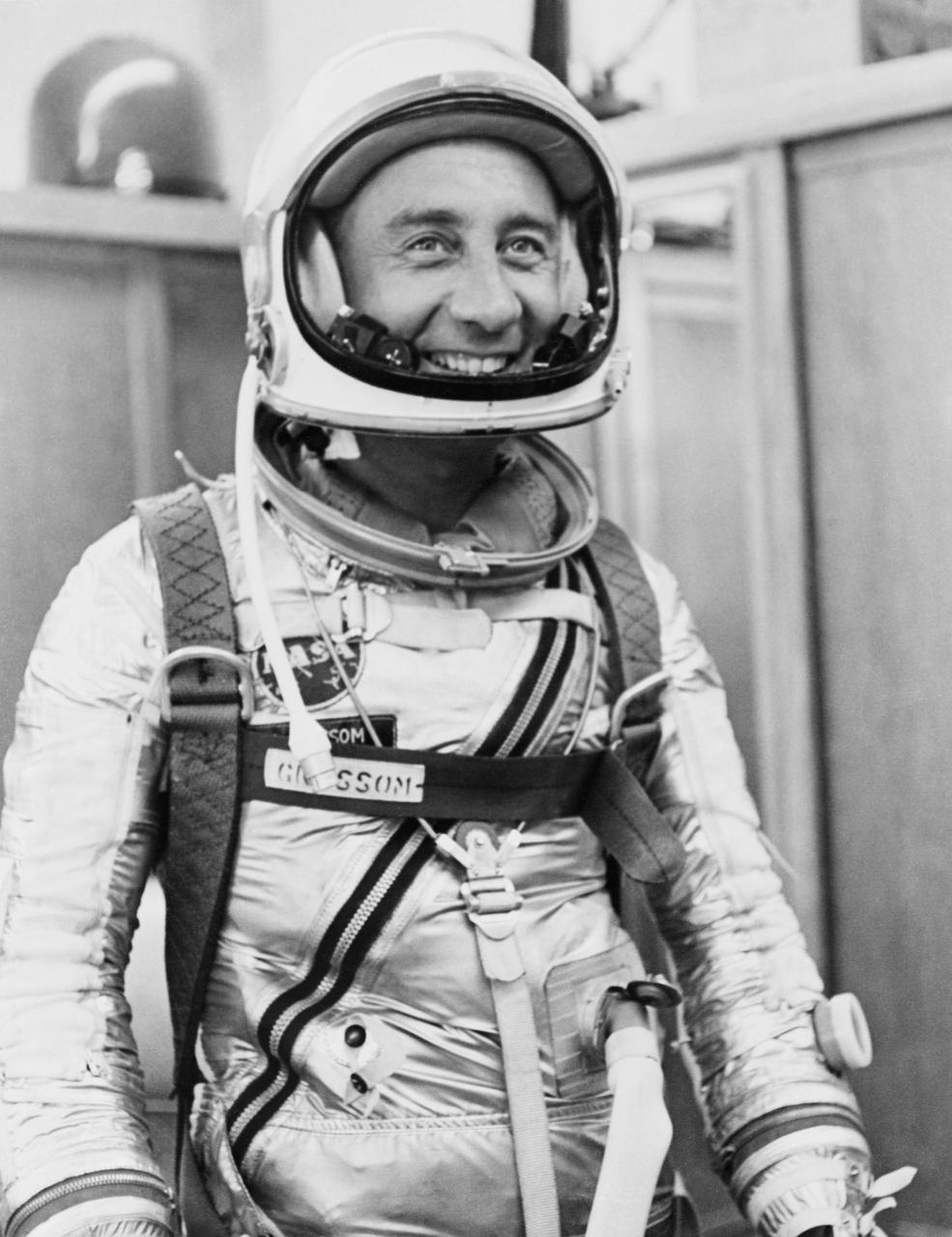
The spacecraft was down and floating in the Atlantic, and the man inside it was thinking about the knife.1
On the morning of July 21, 1961, Air Force Capt. Virgil I. Grissom had ridden a Redstone rocket from Cape Canaveral and come down in the ocean 15 minutes and 37 seconds later.1 Lying on his couch in the capsule called Liberty Bell 7, he went through his checklist.1
He wrote it all down afterward for NASA. He had unstrapped himself, disconnected his helmet and rolled up the rubber neck dam on his suit. He had taken the knife from the door and put it in the survival pack. He had removed the cover and the safety pin from the hatch detonator.1
Then he waited for the recovery helicopter to call for him to blow the hatch.1
“I was lying flat on my back at this time and I had turned my attention to the knife in the survival pack,” he wrote, “wondering if there might be some way I could carry it out with me as a souvenir.”1
“I heard the hatch blow—the noise was a dull thud—and looked up to see blue sky out the hatch and water start to spill over the doorsill.”1
The next day, at a news conference in a Cocoa Beach motel, he described the same moment differently.2,3 “I was lying on my back minding my own business,” he said, “when ‘pow!’ The next thing I knew I could see blue sky and water coming over the sill.”4
A dull thud in the official report; “pow!” for the press. The man from Mitchell, Ind., told the story both ways. The spacecraft sank in about 16,800 feet of water.4
Two versions in his own words
The written report, part of NASA’s published results of the flight, is the more careful of Grissom’s two accounts. It is also the harder on himself.1
In the water, he wrote, he was at first “floating quite high up.” Then: “But the neck dam was not up tight and I had forgotten to lock the oxygen inlet port; so the air was gradually seeping out of my suit.”1
He was “going under water quite often,” he wrote, and “swallowing some salt water.” When the rescue sling, called a horsecollar, finally reached him, “I knew that I had it on backwards,” but he held on anyway.1
At the news conference, he had been kinder to his own work. A report on the transcript in the Key West Citizen quoted him saying he had rolled up the neck dam “so that if anything occurred, I would at least float. That was the best thing I did all day.”3
But he also told reporters, according to the partial text of the news conference printed in the Washington Evening Star, “I had neglected to close a port down on my suit so I was getting water into the suit and getting lower and lower in the water all the time.”2
The transcript also has him saying something the legend of Liberty Bell 7 usually leaves out. Asked about the hatch, he said: “I think probably if I hadn’t pulled the safety pin maybe it wouldn’t gone. I don’t know. But this is something we still have to investigate.”2
Asked whether he had felt in danger, he answered: “Well, I was scared a good portion of the time. I guess this is a pretty good indication.”2
He also said, asked whether the flight was as interesting as Alan Shepard had found his, “I’d recommend the trip to anyone.”2
NASA’s published report did not settle the question. In the engineering summary, the hatch was “the major difficulty” of the flight, and its “premature separation” was “as yet unexplained.”1
The same report describes how the hatch worked. It was new: “The explosively actuated side hatch was used for the first time on the MR-4 flight.” Seventy titanium bolts held it on. Once the safety pin was removed, the igniter needed a force of “around 5 pounds.”1
The report also records what the flight cost him. “The loss of the spacecraft was a great blow to me,” Grissom wrote, “but I felt that I had completed the flight and recovery with no ill effects.”1
The longest 15 minutes
In Mitchell, his parents watched on television.5
The Associated Press reported that his father, Dennis Grissom, a railroad signalman, felt mostly fear—“pride ran second.” At one point he walked into the kitchen, away from the television. The astronaut’s mother, the AP said, “stuck out every tense moment.”5
“It was the longest 15 minutes I ever lived through,” the father said. “You wouldn’t realize this unless you had a son up there.”5
Asked how he felt when the capsule went down, he said, “I was proud he was out of it.”5
A reporter asked whether there had been tears. “What do you think?” Mrs. Grissom said. “What would you do?”5
The night before, the family had gone on a picnic with about 40 relatives—“mostly my wife’s,” Dennis Grissom said. Their nerves were on edge, the AP said, partly because the flight had already been postponed twice.5 “I just kinda got a feeling they’ll call it off,” he had said before turning in.5
After the flight, the Grissoms got ready to ride in a parade with the high school band and the town’s one fire truck. The AP put Mitchell’s population at 3,550.5
Four days earlier, when his son was officially chosen for the flight, the AP had found his father calm. “We’ve known for some time it would happen,” he said. He had already scheduled that week as vacation from his job as a signal maintenance man with the Baltimore & Ohio Railroad.6
The boy who carried papers
Virgil Ivan Grissom was born in Mitchell on April 3, 1926, according to NASA.6,7 A 1961 Evening Star profile gave his birthday as April 23; NASA’s biography and the Indiana Historical Bureau both give April 3, and they are the better sources.6,7,8
The profile is still the best period account of his boyhood. It said he carried papers on two routes, one in the morning and one in the afternoon. He was “too slight and short” to make the high school basketball team.6
His father, it said, kept his railroad job through the Depression, “though its pay diminished to $24 a week.” The boy kept a vegetable garden to help. Friends called him “Greasy,” which the paper said was “merely a name that alternated with Grissom.”6
In high school, the profile said, there was “just one girl, Betty, his wife-to-be.”6 Betty Moore was from Mitchell too.9
The Indiana Historical Bureau says he served in the Army Air Corps as an aviation cadet in 1944.8 The Star said he spent the war “behind a typewriter.”6
He and Betty married, and he went to Purdue University. An official of the university wrote to the Star: “Betty worked, and Virgil fried hamburgers for 30 hours a week from the summer of 1949 to his graduation.”6
The official added that he had detasseled corn one summer and “later worked as a machinist helper on a night shift in the Monon railroad roundhouse,” and that Betty “worked for three years as a long distance telephone operator.”6
He graduated in 1950 with a degree in mechanical engineering.6,8
Korea, Edwards, and the seven
He earned his Air Force wings in March 1951 and flew 100 combat missions in Korea in F-86s with the 334th Fighter Interceptor Squadron, according to NASA. He came home in 1952 to teach jet flying at Bryan, Texas.7
He was decorated with the Distinguished Flying Cross and the Air Medal with cluster for his Korean service.7
He studied aeronautical engineering at the Air Force Institute of Technology, went to the Test Pilot School at Edwards Air Force Base in October 1956, and in May 1957 returned to Wright-Patterson Air Force Base as a test pilot in the fighter branch.7
In April 1959 NASA named him one of the seven Mercury astronauts.7 The Evening Star’s list read “Capt. Virgil Grissom of Mitchell, Ind.”10
At the 1959 news conference with the seven, a reporter asked each man to characterize his motivation. “We are all serving the Nation, and here is another opportunity,” Grissom said.11 Asked about his family, he said: “My wife feels the same (as I do) or of course I wouldn’t be here.”11
In 1961, the Star reported that before their selection, Grissom and fellow astronaut Leroy Cooper had been taking off in a T-33 jet trainer when the landing gear collapsed. The plane crashed and burned; both men escaped unhurt.9
The same article recalled what happened when the astronauts were asked, after their selection, whether a rocket ride was especially hazardous. Grissom said it would be nothing compared with the ordeal of Allied troops waiting to invade Normandy in World War II.9
“Those people didn’t know what to expect on D-Day. We do,” said Scott Carpenter. “And they knew there was going to be a slaughter. We don’t admit that,” Grissom added.9
The family on the lawn
Betty Grissom and their sons, Scott, 11, and Mark, 7, followed the flight from their home in Newport News, Va.12
“I am happy,” she told reporters on the lawn, “but I am so sorry the capsule was lost.”12
She said she and the boys had talked to him by phone as he lay in the capsule before launch. “He said if we stopped talking he could go to sleep,” she said, and laughed.12
A reporter told her that her husband had tidied up the spacecraft before leaving it and asked whether he was as tidy at home. “He does not pick up things around the house very well,” she said.12
The next day’s Star quoted her: “I almost cried when the capsule sank.”13
Home to Mitchell
In June 1962, Mitchell held a homecoming for him.14,15
The AP reported that he spent the night at his parents’ home on Grissom Avenue, newly renamed. The airport at nearby Bedford had also been renamed for him.14 He had stopped first at Louisville, where he was made a Kentucky colonel. “It’s easier to get promoted in Kentucky than in the Air Force,” he said.14
He laid the cornerstone for the new Mitchell Junior and Senior High School, to be named the Virgil I. Grissom Building. Betty, “his high school sweetheart here,” helped him.15
The AP said the celebration “attracted most of the 3,552 residents” of the town. Grissom, it said, “smiled constantly—but had little to say.”15
He accepted the town’s tributes on behalf of “my six teammates, who are working today while I am loafing in the sun.” His speech to the crowd was short: “Thank you very much. It was an overwhelming day. You’re all wonderful people.”15
Molly Brown
On March 23, 1965, Grissom became the first person to go into space twice.16,17
He was command pilot of Gemini III, the first Gemini flight with a crew, with John W. Young as pilot. They lifted off from Launch Pad 19 at 9:24 a.m. and made three orbits.16
The spacecraft was called “Molly Brown,” after the Broadway musical The Unsinkable Molly Brown.18 The National Archives says the name referred to Grissom’s Mercury flight, when Liberty Bell 7 sank.19
At liftoff, capsule communicator and fellow Mercury astronaut Gordon Cooper radioed, “You’re on your way, Molly Brown.” “Yeah man!” Grissom answered.18
Near the end of the first orbit, Grissom and Young fired the maneuvering thrusters for 1 minute, 14 seconds. A second burn 45 minutes later changed the tilt of the orbit slightly. NASA calls that maneuver “the first orbital change by any piloted spacecraft.”18
The flight is also remembered for a sandwich. According to the National Archives, Young smuggled a corned beef sandwich aboard in a suit pocket and offered Grissom a bite. Both men were reprimanded.19
Grissom later served as backup command pilot for Gemini 6.7
Plugs out
He was then named command pilot of the first Apollo flight with a crew, designated AS-204.7 His crewmates were Edward H. White II and Roger B. Chaffee.8,17
On Jan. 27, 1967, the three men climbed into the command module on the launch pad for a countdown rehearsal the Review Board called the “Plugs-Out Test.”7,20
The Apollo 204 Review Board later reconstructed the day minute by minute.20
Grissom entered the spacecraft at 1:00 p.m. Eastern time. He “noted an odor” in the suit oxygen loop, and the count was held while a sample was taken. The Board concluded the odor was “not to be related to the fire.”20
Through the afternoon there were communications problems, including “a continuously live microphone that could not be turned off by the crew.” In its chronology of the fire, the Board refers to “the Command Pilot’s live mike.”20
At 6:31:04.7 p.m. Eastern, a crew member reported a fire in the command module.20
The cabin was full of pure oxygen at 16.7 pounds per square inch. The Board’s finding was blunt: “The test conditions were extremely hazardous.”20
The procedure called for White, in the center couch, to open the inner hatch. Witnesses watching on television saw motion that suggested he was reaching for the handle. His harness buckle was found unopened, a sign he had begun the standard procedure.20
“Due to internal pressure,” the Board found, “the Command Module inner hatch could not be opened prior to rupture of the Command Module.” The crew, it said, “was never capable of effecting emergency egress.”20
The cabin wall ruptured about 15 seconds after the first report. Pad workers needed about five minutes to open all three hatches. The Board concluded that resuscitation was impossible by then.20
“Death of the crew was from asphyxia due to inhalation of toxic gases due to fire,” the Board found. Autopsy data led to “the medical opinion that unconsciousness occurred rapidly.”20
The Board found Grissom “lying supine on the aft bulkhead or floor of the Command Module, with his helmet visor closed and locked.”20
The Board did not identify the exact ignition point. It said the fire was most probably started by an electric arc near the Environmental Control System equipment.20
The sources do not agree on when the mission would have flown. The Indiana Historical Bureau gives Feb. 14, 1967, for a planned 16-day mission.8 Arlington National Cemetery gives Feb. 21.17 Hoosier First could not settle the date from the records it checked.
The two hatches
Six years apart, a hatch was at the center of the end of two of Grissom’s missions.
In 1961, a new explosive hatch came off before he was ready, and NASA’s report could not say why.1 In 1967, the inner hatch of the Apollo capsule could not be opened against the pressure inside.20
The Board’s recommendation was “that the time required for egress of the crew be reduced and the operations necessary for egress be simplified.”20
Arlington and home
Grissom was buried at Arlington National Cemetery, in Section 3, Grave 2503-E. Chaffee is buried next to him.17
He was posthumously awarded the Congressional Space Medal of Honor.7 In 1967, Bunker Hill Air Force Base in Miami County, Ind., was renamed for him.8
At Spring Mill State Park, near Mitchell, a memorial holds his helmet from the Mercury flight, along with the Gemini III capsule and his space suit, according to the Indiana Historical Bureau.8
So the capsule named for an unsinkable woman ended up in a state park near the town where he carried papers as a boy.6,8 Of the knife he wanted as a souvenir, his report says only that he had put it in the survival pack.1
How he died
Gus Grissom died with Edward H. White II and Roger B. Chaffee in the fire inside the Apollo command module at Launch Complex 34 on the evening of Jan. 27, 1967, during the “Plugs-Out Test.”7,20
The official finding is the Apollo 204 Review Board’s: “Death of the crew was from asphyxia due to inhalation of toxic gases due to fire.” Autopsy data, the Board said, supported “the medical opinion that unconsciousness occurred rapidly.” The cabin was filled with pure oxygen under pressure, and the inner hatch could not be opened against it; the crew “was never capable of effecting emergency egress.”20