The Credit Line
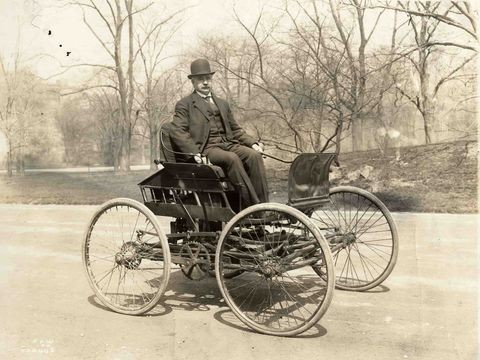
Elwood Haynes’s 1894 car sits in the Smithsonian under a label that names one builder. For decades, his company and the two brothers who built the car with their own hands fought over that label in advertisements, telegrams and tablets. The papers show how the fight was waged, and how close the two sides really were.
On July 24, 1912, the assistant secretary in charge of the U.S. National Museum in Washington wrote a short letter to Elwood Haynes in Kokomo.
“Referring to your letter of July 10, in reply to my communication of the 8th, with reference to the automobile which you presented to the National Museum in 1910, I beg to say that there seems to be no reason for making any change in the label which has all along been displayed with it,” the letter said. “The Apperson Brothers have been so informed.”1
The label read: “Gasoline automobile built by Elwood Haynes in Kokomo, Ind., 1893-1894. Successful trial trip made at a speed of six or seven miles per hour, July 4, 1894. Gift of Elwood Haynes, 1910.”1
Hoosier First found the letter because the Haynes Automobile Company printed it in a newspaper. A year after it was written, in July 1913, the company published a statement in the Salt Lake Tribune that reproduced the letter and the text of the label. The Apperson Brothers Automobile Company, the statement said, had “endeavored to have this placard read in such a way as to deprive Elwood Haynes the rightful credit.”1
The state of Indiana tells the story of Haynes’s car in a single sentence: on July 4, 1894, he made the first test run of an automobile he designed and built, at about seven miles per hour, on Kokomo’s Pumpkinvine Pike.2 The newspapers show that for decades the most contested words in that sentence were “and built.”
Haynes & Apperson
In the earliest newspaper items Hoosier First found, the two names were joined.
In October 1895, a list of entries for the coming horseless carriage contest in Chicago included Haynes & Apperson of Kokomo, alongside Charles Duryea.3 On Nov. 17, 1895, the Indianapolis Journal’s Kokomo correspondent reported that “Messrs. Haynes and Apperson, of this city, have completed two motocycles of their own invention” and would start both in the race at Chicago on Thanksgiving Day, competing for a $5,000 prize. The vehicles, it said, “have been thoroughly tested on the streets and highways.”4
The race was run on a 54-mile course “a foot deep in snow and slush.” The judges awarded the first money prize, $2,000, to the Duryea Motor Wagon Company of Springfield, Mass. Further down the list of awards, Haynes & Apperson of Kokomo received $150.5
In August 1897, a Boston dispatch reported that a horseless wagon race “had only two contestants,” and that the wagon made by Haynes & Apperson of Kokomo “won two heats.”6 In July 1899 the Indianapolis Journal reported that “Messrs. Haynes and Apperson, manufacturers of the Kokomo automobile,” had received a telegram from the New York Herald asking them to substitute their machine for a Duryea carriage the Herald had sent across the continent, which was “making such slow progress.” The offer could not be accepted; that Kokomo car had been sold to a Brooklyn man.7
None of the 1890s items Hoosier First found described the July 4, 1894, trip itself. In the newspapers Hoosier First reviewed, the date appears later, on the Smithsonian label and in the Haynes company’s advertising, which reprinted the label word for word.1,8
A gift and a label
By 1907 the car was being described as a museum piece. The New York Tribune reported in March of that year that the Smithsonian “has recently recognized the fact that the Haynes people are the oldest automobile builders in America by obtaining for its museum the first car built by this company.”9
That was premature. In April 1908, the Los Angeles Herald reported that Haynes had arrived in New York “with the car he made in 1893,” ahead of an automobile parade. “Within a few hours the pioneer builder was arrested at Fifty-seventh street and Broadway by Bicycle Officer T. H. Kerrigan for running an automobile without a number.”10 The museum’s own label gives the year of the gift as 1910.1
The telegrams of 1913
The argument came into the open in the summer of 1913, while Haynes was riding with a tour of Indiana automobile men from Indianapolis to the Pacific.1
The Haynes company’s July 1913 statement printed what it called its “final telegram” to the Apperson company, sent from Denver. It answered the Appersons with a list of comparisons. “Graham Bell invented the telephone but never made an instrument,” it said. “Robert Fulton invented the steamboat, but bought his engine abroad. Edison invented the incandescent light but never blew a bulb.” None of the mechanics who built those inventions, it said, had “endeavored to take credit to themselves.”1
“Elwood Haynes invented the American gasoline automobile and Elmer Apperson and other mechanics assisted in building the first Haynes car,” the telegram went on. It said that Edgar Apperson had suggested to a man named George H. Strout that the two companies “should get up a fight of some kind, stating that the newspapers would ‘fall for it,’ and that both companies could get a lot of publicity.” In his speeches on the tour, the telegram said, Haynes had given the Appersons “all, and possibly more, credit than is due them.” It ended with a challenge: “If any statements that this company has made are not true, your recourse is to sue our company in the courts.”1
Hoosier First found no record that either company sued.
Not every paper along the route took the Haynes side. The Daily Sentinel of Grand Junction, Colo., ran an item headlined “Haynes, Peeved Because He Was Ignored, Knocks.” It said Haynes had wanted to be the principal speaker at the tour’s Indiana banquet in the town and had been turned down, because “Mr. Haynes’ addresses have been largely about Mr. Haynes” and the local committee wanted to hear about the Lincoln Highway instead. It said his claim to “America’s first automobile” was disputed and that he used it “as an advertising proposition for his car.”11
The man in the Apperson shop
The Appersons told the story differently, and in their version Haynes did not always have a name.
In March 1914 the Washington Herald printed a long feature, “Appersons Have Wonder Touch,” that called the site of the brothers’ Kokomo plant “the birthplace of the first American-made gasoline automobile.” In it, “one of the few financially independent men of Kokomo” walks into the Apperson workshop in October 1893 and asks Elmer Apperson why he and his brother do not build a horseless carriage. Apperson, the article said, took an envelope from his pocket and sketched on the back of it “his idea of how a motor-car could be successfully built.” The visitor offered to back the brothers “for the material of their first car.”12
In the article’s telling, the visitor stays nameless while the car is designed and built. He gets a name only afterward, when the car’s success “attracted the world to the little town of Kokomo, and the man of finance Elwood Haynes by name went into a partnership with the Apperson brothers.”12
By 1917 at least one paper had decided the question did not matter. The Custer Weekly Chronicle, in South Dakota, wrote that the Smithsonian was showing “what is commonly accepted as the model of the first automobile ever built in the United States,” the car built by Haynes. “Whether Elwood Haynes or Elmer Apperson or Alexander Winton or somebody else built the first motor propelled car in America or not, is not a matter for serious consideration at this particular time,” it said.13
A tablet and a reply
In 1918, 25 years after the car was begun, the argument took a new form. The New York Tribune reported in December that the Press Club of Indiana had presented the Apperson brothers with a tablet, awarding them the honor of producing the first commercially practicable automobile in America.14
The Tribune then printed a reply from Eddie Edenburn, the automobile editor of the Detroit News. Edenburn had worked for the Indianapolis News and had been advertising manager for the Apperson organization in 1913. He reported that the Indianapolis News “seemed never to have heard of the Press Club of Indiana.”14
Edenburn’s account of the building of the car was the most detailed Hoosier First found in a newspaper. Haynes, he wrote, “worked out his ideas on paper, had blue prints made and contracted with the Riverside Machine Works, owned and operated by the Apperson boys, to build the machine. It is generally understood in Kokomo that the contract was an agreement that Haynes would pay for materials and the labor at 40 cents an hour.” J. D. Maxwell, “who afterwards fathered the Maxwell-Briscoe, the parent of the present Maxwell car,” was employed by the Appersons. “In the construction of the machine the Appersons, being practical mechanics, made slight changes in Haynes’s plans, with his approval.”14
“The altercation over the ‘first car’ has a life lasting a score of years,” Edenburn wrote. “It has been discussed in Indiana more often than in any other section of the country and has furnished ‘publicity’ material for both parties to the argument.”14
Elmer Apperson’s death
Elmer Apperson died of apoplexy in Los Angeles on March 28, 1920. He was 58.15 The obituaries had to choose a version.
A Kansas paper, the Liberal Democrat, gave the Appersons the larger share. “In 1893, he, with his brother, Edgar Apperson, and Elwood Haynes, constructed the first automobile in the Riverside Machine Shop in Kokomo,” it said. “The Appersons were the mechanics and Mr. Haynes was the financial head of the venture.”16
The New York Tribune split it. The brothers, it said, had “built to the design of Elwood Haynes the first real automobile in America.” Later in the same column it added: “It appears pretty definitely established that the Appersons built it and Elwood Haynes designed it. Surely there is glory enough for all, the more so that no matter whose individually is the triumph, geographically it belongs to one small city, Kokomo, Ind.”15
June 1920
Two months later, both companies paid for space on the same weekend.
On June 12, 1920, the Haynes company ran an advertisement in the Indiana Daily Times addressed to the advertising men at a convention of the Associated Advertising Clubs of the World. It congratulated the clubs’ National Vigilance Committee “upon the thoroughness of its research and its conscientious insistence upon the verities in public statements.” The company, it said, “has never participated in the discussion over who made America’s first car, further than to state that Elwood Haynes invented, designed and built it, and to rest its case with history.” It complained that the accuracy of the museum’s label had nevertheless been “directly and indirectly questioned.” The ad ended: “The Haynes is America’s first car.”17
Hoosier First did not find a published finding by the Vigilance Committee, and the ad does not quote one.
The next day, June 13, the Apperson Bros. Automobile Company ran a long statement in the Washington Evening Star. Its title promised “The Exact Facts” on who actually built the first mechanically successful American automobile.18
“An erroneous impression has been gained by a few that a controversy exists relative to the ‘First Car’ matter,” it said. “We wish now to publicly announce that this is not true.”18
The Apperson statement gave Haynes the idea. “Thus it was Elwood Haynes, who initiated the idea which developed into the first mechanically successful American made motor car,” it said. But it claimed the engineering for the brothers. “The actual mechanical work on this first car was done by the Apperson Brothers and their employees,” it said, and the brothers “were the engineers to design and produce the first successful American made motor car of the internal combustion type.” It said the motor was “a small launch type, purchased from a marine motor company.” And it explained why the car carried Haynes’s name: “Inasmuch as the material and labor entering into the construction of this car were paid for by Elwood Haynes, it became his property.”18
The statement then quoted the Smithsonian label in full, the same label the Haynes company had defended in 1913. It also quoted the New York Globe, which had written in April that “there is no doubt that it was built by the Apperson Brothers in the Riverside Machine Works,” and the Kokomo Tribune’s editor, Edward M. Souder, described as a boyhood playmate of the brothers. Souder wrote that the Riverside Machine Works “became actually, tho not in name, the first automobile factory in America, for it was there after plans suggested by Elwood Haynes” that Elmer Apperson and his brother Edgar “built the first gasoline motor car constructed in this country.”18
Read side by side, the two statements of June 1920 disagree less than their tone suggests. Both put the idea with Haynes. The Haynes ad says he designed the car; the Apperson statement says he suggested the plans and paid for the work done in the brothers’ shop. Both lean on the same museum label.17,18 What they disagree over, in the end, is one word: whether the man who paid for the car and planned it, or the men who made it with their hands, should be called its builder.
A different question
Outside Kokomo, others were asking a different question: not who in Kokomo built the first car, but whether Kokomo’s was first at all.
In February 1920, the El Paso Herald published an interview with Charles Clifton, described as one of the few living men “who were in at start of industry.” Its headline summed up his history: “First American Automobile Built in 1787, but Was Worthless; Duryea and Haynes Built First That Would Run.” The article named as living pioneers “Charles E. Duryea, Elwood Haynes, the Apperson brothers, R. E. Olds, Alexander Winton, and Henry Ford.”19
The Haynes company’s advertising did not share the stage. From 1913 on, Haynes ads and dealer notices, from Albuquerque to Ardmore, Okla., carried the slogan “America’s First Car.”8,20
The obituaries
Elwood Haynes died at his home in Kokomo on April 13, 1925.21,22 Mayor James Burrows prepared a proclamation “calling on automobile factories throughout the country to cease work during the funeral.”23 Business in Kokomo was suspended on the day of the funeral, and more than 5,000 people filed past his body as it lay in state in the First Presbyterian Church.24
The obituaries did not agree on the details. One wire account gave his age as 67, another as 68, and they differed over whether influenza or heart disorders that followed it had killed him.21,22 One said that on July 4, 1894, he drove his car back into Kokomo “at the remarkable speed of eight miles an hour,” and added a hedge: “That, it is claimed, was the first trip of a gasoline driven vehicle in America.” The Smithsonian’s label had said six or seven miles an hour.1,22 A Berne paper, the Adams County Witness, said that “with the aid of Elmer Apperson, then a Kokomo machine shop proprietor,” he had completed his plans.25
A New Britain, Conn., editorial called him the automobile’s “ostensible inventor” and said that “the claim has not been successfully disputed.” It added that Henry Ford “took more efficient advantage of the result of his tinkerings than did Mr. Haynes.”26
The Adams County Witness also noted a different side of his life. It listed among the inventions “attributed to Mr. Haynes” stellite and “stainless steel (patented rustless steel),” and said that with his death “the Anti-Saloon League also lost one of its best financial supporters.”25
The label
Hoosier First did not see the Smithsonian’s current label for the car and does not know whether its wording has changed.
What the newspapers do show is how the argument over it worked. Haynes’s company built its advertising on three words, “America’s First Car.” The Appersons answered with a longer phrase, “first mechanically successful American made motor car.” Each company had a commercial interest in its version. And the one document both sides quoted in their own favor was the museum label that said, from 1910: “built by Elwood Haynes.”1,18
Edenburn’s 1918 account may be the fairest thing in the file. In Kokomo, he wrote, “the consensus of opinion is that to Haynes belongs the credit.” But “Elwood Haynes, Elmer and Edgar Apperson and J. D. Maxwell all had a hand in the production of the car in question.”14
How he died
Elwood Haynes died at his home in Kokomo on the evening of Monday, April 13, 1925.21,22 The two wire services described the cause differently. The United News said he died “as a result of heart disorders which developed following an attack of influenza,” and that he had been confined to his home since returning from a trip to Washington, D.C., and southern cities several days earlier.21 Another wire report called him “a victim of influenza,” and said he “had never fully recovered from a previous attack of the disease” and “was ill but a few days.”22
Both accounts put influenza at the start of his final illness. Hoosier First did not see a death certificate, so this story does not say which account is more exact.