The Coroner’s Finding
The Indianapolis Motor Speedway opened in August 1909 with a three-day meet that killed at least five people. The Marion County coroner held Carl Fisher’s company responsible, and Fisher admitted under oath that the track was not ready. Within a month, men were paving it with brick.
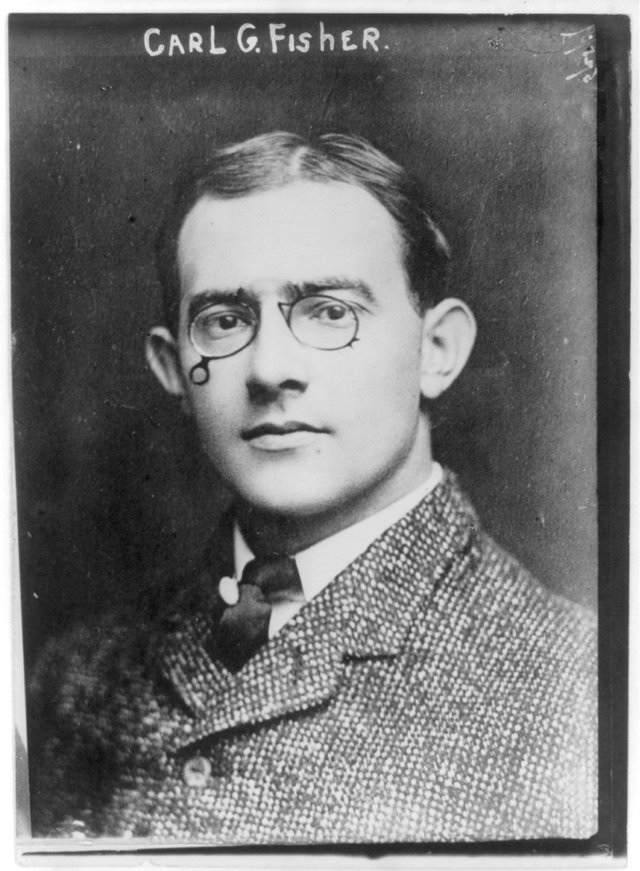
On Aug. 27, 1909, the coroner of Marion County, John J. Blackwell, handed down his finding in the deaths of two men from Springfield, Mass., a race driver named William Bourque and his mechanician, Harry Holcomb.1
“It is clear to my mind that the Indianapolis Motor Speedway company knew there was going to be a loss of life and limb,” the coroner wrote. “The surroundings indicated everything of that kind. They were prepared with a hospital ambulance and every convenience to take care of the dead or dying.”1
“Therefore from evidence here shown and testimony taken I hold the officers and manager of the Indianapolis Motor Speedway company responsible for the deaths of Harry Holcomb and William Bourque, and when the grand jury holds its next session I will recommend an investigation of the whole affair.”1
The president of the Indianapolis Motor Speedway company was Carl G. Fisher.2,3 He had been one of the coroner’s witnesses.1
Indiana remembers Fisher, born in Greensburg in 1874, as a builder: co-founder of the Prest-O-Lite headlight company, co-founder and president of the Speedway, promoter of the Lincoln and Dixie highways.2 The newspapers of August and September 1909 show the moment his best-known project nearly ended before it began, and what he did about it.
The man who built the track
The Speedway was not Fisher’s first stunt of 1909. In June, a national balloon race started from the Speedway grounds, and Fisher entered as a pilot.4 His balloon, the Indiana, was in the air about 48 hours and came down in Tennessee. “Yes, we are safe,” Fisher said by telephone, “thanks to the poor marksmanship of a number of farmers. They began firing on us when we were in Brown county, Ind., and have kept up the target practice ever since.”5
A Washington Times writer who studied the track that August described it as the work of four Indianapolis businessmen, “C. G. Fisher, A. C. Newby, F. H. Wheeler, and J. A. Allison,” built “with a purpose to provide an American track at least the equal of the great English course at Brooklands.” It had been “designed by Mr. Fisher, himself a successful driver several years ago.”6
The Indiana Historical Bureau’s account of the opening meet describes three days of racing, with a 250-mile race the first day, 100 miles the second and 300 miles the third.3
What the drivers said
What the track was made of depended on whom a reporter asked. The Washington Times writer was told by E. A. Moross, the Speedway’s director of contests, that the outer course was built “of crushed stone and a binder of tarviated sand and stone.” But “according to some of the drivers it is only a surface of sand and powdered stone with oil sprinkled and rolled upon it.” Brooklands, the paper noted, was concrete.6
The same writer collected what the drivers told him after the meet. According to Lewis Strang, he wrote, every car racing at Indianapolis was off the ground “practically all the time.” Many drivers “were sick from pain after merely warming up their engines by a spin around the track,” and “more than one went temporarily blind.” The drivers, he said, thought flying “safe as ridin’ in a baby carriage” compared with what they had just done.6
Nobody agreed on what the place had cost, either. The Washington Times said the tracks had cost more than $300,000. A wire story after the deaths called it “the $400,000 motor speedway.” A Hammond paper, a month later, said the improvements then under way would bring the investment to “a little less than $700,000.”6,7,8
Thursday
The first day was Thursday, Aug. 19, 1909. The feature was the 250-mile race for the Prest-O-Lite trophy, named for Fisher’s own company.9
Bourque, driving a Knox car, had been gaining all afternoon. “Bourque was not regarded as a contender for the $1,000 prize until a few minutes before the end came for him and Holcomb,” the Richmond Palladium reported. “He had been gaining steadily, however, and was fairly burning up the macadam surface.”9
A Plymouth paper said the car “suddenly left the track while plunging along at a speed of seventy-five miles an hour, turned a complete somersault and dashed both men against the fence which surrounds the course.” Twelve thousand people, it said, saw it happen. “Scores of women fainted at the sight.” The paper said the machine skidded, left the track and “with undiminished speed struck a small ditch which borders the speedway,” and that “just why the racer left the track is a mystery.”10 The Palladium reported that Bourque died as he was placed in an ambulance and that Holcomb “died a few minutes after he reached the Emergency Hospital on the Speedway grounds.”9
The day also set records. Barney Oldfield, in a Benz, ran a mile in 43.1 seconds, and Louis Chevrolet, in a Buick, ran ten miles in 8 minutes 56.4 seconds; wire reports called both new American track marks. Robert Burman won the 250-mile race in 4 hours 38 minutes, a time the report called “slow because of the many accidents that marred the race.” Only four of the ten starters finished.11
After the deaths, the American Automobile Association issued what wire reports called an ultimatum to the track’s owners: “certain changes must be made by today or the sanction for the event will be withdrawn.” The association, the reports said, demanded “that the track be freed from the many and dangerous ruts.”11
Saturday
The meet went on. On Saturday, Aug. 21, during the 300-mile race, a National car driven by Charlie Merz blew a tire on its right front wheel and went through the fence.12
“Death again put in its claim at the motor speedway this afternoon and this time it actually stopped the events,” the Palladium’s Indianapolis dispatch said. “The low fence around the speedway was lined with spectators at this point, all engaged in cheering on the riders.” The car turned over on Merz. His mechanician was thrown against the fence and died a short time later. Two spectators were killed.12
The events were stopped. The dispatch was headed “Races Claim Five Victims in 3 Days.”12
How many, and who
The newspapers did not agree on how many had died, or on who they were.
The Palladium’s count of five covered Bourque, Holcomb and the three killed Saturday.12 A wire story printed in the Walkerton Independent counted six. It added Clifford Litteral, 27, of Dayton, Ohio, a mechanician who it said was struck by a racing car on his way to the Speedway for practice the Tuesday before the meet and died on Thursday. “With a death list of six for three days’ racing,” it said, “it is doubtful if the $400,000 motor speedway in this city ever will be used for automobile racing again. The better class of Indianapolis citizens say they do not care for the sport at such a sacrifice of life.”7 A Minnesota paper’s headline said the coroner had blamed the Speedway for “Two of Six Fatalities.”13
The names of Saturday’s dead varied from paper to paper. The Palladium listed Merz’s mechanician as “Claude Kellum” of Kokomo; the six-death wire story called him “Clyde Kellum” of Indianapolis.12,7 The Palladium named the two spectators as Benjamin Longman (also printed “Lougan”) of Indianapolis and John Jolleffe of Trafalgar. The wire story named them as James West, 29, an Indianapolis meat cutter, and Homer H. Joliff of Franklin, whom it described in one paragraph as 20 years old and in another as “28 and unmarried, a farmer, who had motored here from Trafalgar.”12,7 A Springfield, Mass., paper called the driver “Wilfred Bourque.”14
Hoosier First could not settle these differences from the newspapers alone. It reports them as printed.
The inquest
The inquest records were published on Aug. 26. According to a United Press report, “Carl G. Fisher, president of the speedway company, admitted the track was not completed. Gangs of workmen were busy between the contests and built a hospital in anticipation of accidents. He admitted that there was at least one spot on the track that was perilous.”15
The Spokane paper that ran the dispatch put it under the headline “No Wonder They Were Killed.”15
The coroner’s finding went further. “I find by my investigation that the roadway was not in condition for fast racing by automobiles,” Blackwell wrote. “The broken stone that was placed on parts of the roadway and especially for 200 feet where Harry Holcomb and William Bourque met their deaths, was put on only a few days before and was not properly rolled or tamped.” A coat of asphalt had been laid over the stone to try to cement it together, he said, but after the machines had run on it for a short time the stone “worked up through,” which “demonstrated to me that there was no foundation for this roadway.”1
Then there was the ditch. The Knox car, Blackwell found, “swerved into an open ditch twenty inches wide and about two feet deep, that was open for the reception of tiling to drain the low ground. This ditch was on the very edge of the track.” He was “further satisfied that if this open ditch had not been in the position and place in which it was the two men could have ridden their machine and stuck to the track. As it was, they did not have one chance for their lives after they struck the ditch.”1
The Palladium summarized Fisher’s own testimony. “Fisher admitted in his testimony the poor condition of the track.” He also testified that he had examined the wrecked car and “found the axle bed plates broken, one of them especially being badly crystallized.” The paper noted that nothing in the testimony established exactly why the car swerved: “Unless the mechanical defect in the axle plate accounts for it the real cause will never be known, inasmuch as the two men killed are the only ones who might have testified.”1
A second verdict followed for the Saturday crash. “The coroner’s jury today placed the blame for the automobile accidents at the Speedway a week ago in which two spectators and one driver were killed, by holding that the Speedway owners and managers are responsible,” an American News Service dispatch said. “Today’s action throws the blame for a total of five deaths on the Speedway Association. Grand jury action is recommended.”16 (The Palladium’s own list says Saturday’s dead were a mechanician and two spectators, not a driver; Merz was hurt but lived.12)
The finding traveled. Papers from Maine to Mississippi printed short versions of it.13,17,18 Several repeated the coroner’s conclusion that the course “was not properly built for racing.”13,14 A Springfield, Mass., version put the length of torn-up track at 290 feet rather than 200.14
Hoosier First did not find a report, in the newspapers it searched, that a Marion County grand jury acted on the coroner’s recommendation.
Brick
Three weeks after the finding, a Hammond paper carried a short item headed “To Pave Big Speedway.” “An army of workmen will begin today to cover the entire surface of the two-and-one-half-mile race track at the speedway with vitrified brick,” it said. “More than 3,500,000 bricks will be used, with thousands of barrels of cement, costing $30,000.” The total cost of the improvements under way, it said, would exceed $180,000.8
A dispatch three days later explained the reason. “The main object of paving the speedway is to insure greater safety,” it said. “The promoters say that the hard surface will prevent formation of dangerous ruts and holes in the track, no matter what the speed of the racing cars.” Two hundred men would be put to work.19
Finding them was another matter. At the end of September, the Palladium’s Indianapolis correspondent reported that the Speedway was “advertising for two hundred laborers, and it can not get them.” The track was “being paved with a brick pavement,” and “the speedway people are nearly crazy over the failure to get enough men to do the work, for it hopes to get the track done in time to hold some more races in October.”20
The track’s next record trials came on Dec. 17, 1909, in weather so cold that, as one wire report put it, “the lives of drivers were placed in jeopardy.” Lewis Strang, driving a 200-horsepower Fiat, “was threatened with frozen hands and face. He rubbed his hand and face with snow, however, and gamely refused to quit.”21 The New York Tribune reported that “the lubricating oil on some of the racing machines froze,” and that Johnny Aitken, in a National, broke world records for his class from one to 20 miles.22 The second day’s program was canceled.21
Today, Crown Hill Cemetery, where Fisher is entombed, gives the number of paving bricks as 3.2 million, and credits Fisher with having “convinced the investors” to lay them after a first race “plagued with numerous crashes because of the loose rock of the track.”23 The 1909 papers gave 3.5 million as the planned figure.8,19
After
The Speedway did race again. Beginning in 1911, according to the Indiana Historical Bureau, it held a 500-mile race that became its main event; the first was won by Ray Harroun.3 The state’s marker for Fisher calls the Speedway a “testing ground for new automobile technology.”2
The Bureau’s notes quote Fisher, looking back in a 1937 letter, on why he wanted the track at all. In 1906, he wrote, he “could see that it was a lack of being able to test the cars over a continuous speed run; and I made up my mind then to build a speedway where cars could be run 1,000 miles in a test, if necessary.”3
Fisher went on to promote the Lincoln Highway in 1912 and the Dixie Highway in 1914, and to develop Miami Beach.2 He died on July 15, 1939, in Miami. In 1943, his remains were brought home to Crown Hill.3
The Speedway’s own origin story often begins with the bricks. The newspapers of 1909 show what came before them: a crushed-stone track laid days before the first race, a drainage ditch at its edge, a field hospital built in advance, at least five dead, and a coroner who wrote that the company “knew there was going to be a loss of life and limb.”1 The man who ran that company testified that the track was not ready. Then he paved it.
How he died
Carl Fisher died on July 15, 1939, in Miami Beach, Fla., the resort city he had developed. He was 65.24,25 An Associated Press report from Miami Beach that day, printed in the Laredo Times, said he “died today of gastric hemorrhages.”24 The United Press dispatch printed in the Nome Nugget gave his age and his place in Speedway history but did not state a cause.25 Hoosier First did not see a death certificate.
In 1943, his remains were brought home to Crown Hill Cemetery in Indianapolis.3