The Member from Marion
In 1902, the author of The Gentleman from Indiana ran for the Indiana House and won. Newspapers from his one session show a novelist who ruined a suit shaking hands in a paint shop, nominated a U.S. senator, defied a governor of his own party, and went home with typhoid fever.
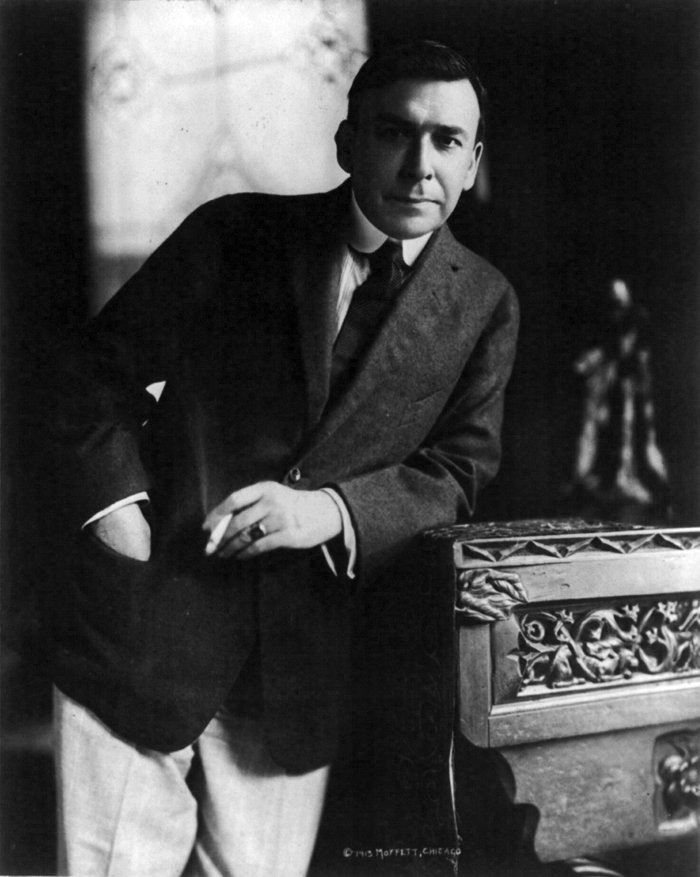
The state historical marker outside Booth Tarkington’s last home, at 4270 N. Meridian St. in Indianapolis, tells the story most readers know. Tarkington was a best-selling novelist, born in Indianapolis in 1869. His first novel, The Gentleman from Indiana, came out in 1899. He wrote the Penrod stories and won Pulitzer Prizes in 1919 and 1922.1
The Indiana Historical Bureau’s research notes for that marker add a shorter story. Tarkington’s early books, the notes say, “proved enough to get him elected to the House of Representatives” in Marion County in 1902. Citing Justin E. Walsh’s history of the General Assembly, the notes say he “served only one session, becoming completely disillusioned with politics.” He then used the experience in his 1905 novel In the Arena, “which was set in a midwestern legislature.”2
That session ran from January to March 1903.3,4 The Indianapolis Journal covered the Statehouse closely, and it covered Tarkington more closely still. Its pages, along with those of other Indiana papers, show what one session looked like from the inside.
The literary man’s nomination
Tarkington’s name appeared in March 1902 in the Journal’s list of Republicans seeking nomination for the House in Marion County.5 The same page carried a note from a meeting of the Western Association of Writers. Tarkington might go abroad that summer, it said, and that would “be a surprise to his political friends, who expect him to make an aggressive canvass in the event of his being nominated for representative.”5
He was nominated. The Journal’s editorial page treated the result as a compliment to literature. “Mr. Tarkington’s nomination,” it wrote, “is the tribute which the Republican party of Marion county pays to the literary man.”6 Candidates had to file statements of what they spent. The Journal printed his under the heading “Newton Booth Tarkington, successful candidate for legislative nomination.” It listed a committee assessment, advertising and cigars.7
Outside Indianapolis, the view was cooler. The Columbus Republic noted that October that Tarkington “is unknown to the party workers,” but that “the fame of his stories” had been “sufficient to land him a nomination.”2
The paint room
The fall campaign gave the Journal its best Tarkington story. On Oct. 31, 1902, he joined a group of Republican candidates on a tour of the D. M. Parry Manufacturing Company. It was a big factory whose painters finished wagons and buggies. The candidates took 1,600 cigars with them, the Journal reported.8
Tarkington, it said, arrived “in finer feathers than those in which he arrayed Monsieur Beaucaire.” In the paint room, the workers’ “faces and hands were paint-covered and coats of varnish made them glisten and shine.” When a workman hesitated — “Oh, Mr. Tarkington, I can’t shake hands; they are all covered with paint” — the candidate answered, “Put her there! They are no worse than mine.” After an hour in the factory, the Journal said, his suit “was ruined.”8
He kept his coat buttoned in the heat. When a fellow candidate, “Cy” Clark, asked why, Tarkington whispered back, according to the Journal: “Darn it all I can’t! I’ve got on a fancy vest!”8
The stump speeches were short. At a Republican meeting held in a shoe shop near Fletcher Avenue and Shelby Street, he told the crowd: “The issue of this campaign, it seems to me, is to get out the vote.” He described meeting a railroad official who “didn’t know when the election was to be held.” Then he said, “The indifferent voter is a worthless sort of cuss.”9 The next day, the Journal’s editorial page defended the phrase. It “may not have been strictly elegant,” the paper wrote, “but it was expressive.”10
At another meeting, Vincent G. Clifford introduced him as a man “who has attained much honor in the literary field and who will fill his first political position, as a member of the House of Representatives, with distinction and credit.”11
He won. A week after the election, the Journal reported his seat assignment: “in the second aisle from the right, five rows back from the front.” His desk mate would be Vernon Van Fleet of Goshen.12 The Journal also reprinted a joke from the Chicago Post. Its columnist complained that the dispatches were full of other politicians “with not one word about Tarkington.”13
Not every paper was charmed. In December, the Ligonier Banner claimed that Republican leaders had backed his election to add “tone” to their ranks. It predicted he would serve as “a blind” for less respectable legislation.14
The gentleman from Marion
The session opened in January 1903. Speaker Marshall named Tarkington to the select committee on rules.3 The full committee list placed him on the committees for benevolent and scientific institutions and for corporations, and on the joint committee on public buildings.15
His reputation came with him. In mid-January, the Daily Democrat of Decatur reported that Tarkington drew a laugh “at least once a day” by moving that the House adjourn until 10 the next morning. “It is a standing joke,” the paper said, “that he never thinks of getting up before noon.”16 When Chicago papers ran a rumor that he had introduced an anti-cigarette bill, the Journal said the idea “afforded no little amusement” to anyone who knew of “the literary statesman’s weakness for ‘Turks.’”17
Then the Republican majority chose him to nominate Charles W. Fairbanks for a second term in the U.S. Senate. At the time, state legislatures still elected U.S. senators.18 On Jan. 20, 1903, the House galleries filled. The Daily Tribune of Terre Haute reported that Speaker Marshall recognized Tarkington as “The Gentleman from Indiana.” He was greeted with applause that lasted “fully two minutes, much to his discomfiture.”19
The Journal printed the speech in full. Its theme was the word “greatness.” “It is a truism,” Tarkington said, “that no word has been more misused.” He listed examples. An entomologist, he said, called a classifier of butterflies the greatest man of the century, and “at Yale they say that Glass, the right guard, is.”18,20 He praised “the tall men of the Middle West.” And he allowed, to the minority’s benefit, “that there have been great Democrats.”18
The Journal called it “a writer’s address, not the speech of a politician.”21 The Decatur paper said that “Booth Tarkington, the author, naturally attracted the most attention.”22 Fairbanks won the House vote 66 to 33.18
Defying the governor
Two days later, the Decatur paper said some politicians had “thought queer of it” when Tarkington was chosen, but that his speech “was one of the most convincing of the kind ever made here.” Then it wrote that “it was not until today that he blossomed into anything like a leader.”23
The issue was the Indiana Reformatory at Jeffersonville. Gov. Durbin backed a bill to reorganize the reformatory’s governing board. Newspapers called it the governor’s “ripper” bill.22,23 The Journal reported that “the administration forces had got out the party whip” against members of the majority who leaned toward opposing it.24 The Journal reported that the governor had held private conferences with Republican holdouts. Tarkington, it said, “was one of the rebels who was favored with an interview of this character, but it evidently did not have the desired effect.” The paper called him “the mainstay of the opposition in the House.”24
The Decatur paper gave more detail. “It was learned from a reliable source today that the governor is more afraid of Tarkington than of any other member,” it reported. It said Durbin had called Tarkington into his private office “and discussed for more than an hour the ripper bill and urged him not to fight it. But Tarkington had made up his mind that it would not be right to throw out the present board without an investigation, so he informed the governor that he would not budge.”23
He lost. On Jan. 29, the Journal reported, “the amended bill in reference to the Indiana Reformatory was passed by a vote of 62 to 32.” The Democrats were “helpless in the face of an overwhelming and united Republican majority.”25 Hoosier First could not find a roll call showing how Tarkington voted on final passage.
The working member
The rest of the session was less dramatic and in some ways more revealing. Tarkington’s first bill, introduced that same afternoon, let street-railway and interurban companies issue preferred stock that was “preferred in the division of assets as well as dividends.”25
In February, the Journal reported that the Merchants Association and the Manufacturers Club of Indianapolis had agreed on an insurance bill and given it “to Booth Tarkington to be introduced in the House.” It was “a bill for an act to prevent the combinations of insurance companies for the purpose of fixing a uniform classification of risks and schedule of rates of insurance.” Supporters estimated that a similar Wisconsin law had saved Milwaukee merchants and manufacturers “at least $200,000” a year.26
He also fought a bill by Rep. Stansbury to create a state commission to buy school supplies. He gave the Journal a long statement against it.27 When the bill reached the Senate, the Journal found him “circulating busily among the senators” at the English Hotel. He hoped “to secure an amendment to the measure that will at least exempt the city of Indianapolis from its provisions.”28
By late February, the Decatur paper had changed its tone. Tarkington “has rolled up his sleeves and is going after the fire insurance companies,” it reported. “His activity has been a surprise to his friends, who thought he would not take the legislature seriously.”29
Not every vote went with the Marion County delegation. On March 3, the House killed the Gray railroad consolidation bill when a motion to strike out its enacting clause carried 48 to 43. The Journal printed the roll call. Tarkington was among the 43 members “who voted to save the bill.” Rep. Bamberger, another Marion County Republican, was among the 48 who voted to kill it.30
He still avoided some jobs. When a colleague planned to have him preside over the House for an afternoon, Tarkington declined. “They would have me tied in a knot in three minutes,” he told the Journal. If he were called to the chair, he said, he would see that “the House took a recess.”27
Near the end of the session, he served on a conference committee over a Senate amendment that would give Indianapolis broad power to order railroads to elevate their tracks. Tarkington and Sen. Thompson wanted to report in favor of the Senate amendment.31 The fourth member, Rep. Morgan of Marion County, refused to discuss it. When pressed, Morgan “was forced to admit that he had not even read them.” Morgan “turned a blind eye and a deaf ear,” the paper wrote, and the committee reported a disagreement.32
What passed
On March 4, the House passed two Tarkington bills. House Bill 382 appropriated $2,080 a year so that blind men could be taught trades at the Indiana Industrial Home for Blind Men. It passed 70 to 7. House Bill 256, the preferred-stock bill, passed 69 to 0.33
The insurance bill reached the Senate. There, the chairman of the insurance committee, Sen. Dausman, called it “an abomination and an outrage.” A motion to postpone it indefinitely failed, 27 to 17.34 Hoosier First could not determine from the newspapers it reviewed whether the bill became law.
After adjournment, an afternoon paper reported that the only measure Tarkington got through, the bill for blind persons, had been vetoed. Col. Russell B. Harrison told the Journal that the report was “inaccurate.” He said he had prepared the preferred-stock bill and given it to Tarkington to introduce, and that it had passed both houses. The Journal’s headline read “Tarkington’s Bill Signed.”35
French Lick and a silk hat
When the session ended, Tarkington and his wife joined several legislators for a week at French Lick.4 One story from that trip reached the Journal in April. Colleagues spent an evening pretending to urge Tarkington to run for lieutenant governor, to unsettle a senator who was expected to seek it. Tarkington played along. “I haven’t fully decided to make the race,” the Journal quoted him. “I’m ready to stand for re-election to the House, or to make a run for the Senate.”36
A year later, the Journal printed another story from the session’s last nights. In the lobby of the English Hotel, Tarkington made “a glowing apostrophe to the passing of the Legislature and to the passing of the speaker.” Then he seized Speaker Marshall’s silk hat. With a closing line ending “so passes the speaker’s tile,” he “jumped on it with both feet.” The next day Marshall received a new hat, with a note: “From the Indians who scalped you last night.”37
Typhoid
Whatever Tarkington planned next, illness intervened. On May 19, 1903, the Journal reported that it was “the thirty-fourth day of the illness of Booth Tarkington from typhoid fever.” He was “a mere skeleton of his former self, having lost fully seventy-five pounds.”38
On May 27, a report printed in the Plymouth Tribune said that sand had been hauled “around the home and on the streets” near his father’s house on North Pennsylvania Street “to deaden the noise of passing vehicles.”39 By the end of June, the Journal reported that he was “gradually recovering his strength” and had ridden downtown in an automobile. He would leave for Kennebunk, Maine, for part of the summer.40
In April 1904, a former colleague received a card from Tarkington mailed in Germany.41 That August, the Richmond Palladium reported that he was back from “his long European tour” and planned to spend the winter in New York writing a play. He was, the paper said, “the Gentleman from Indiana in name only, it seems.”42
The session in the record
The marker research notes take the standard view of Tarkington’s term: one session, then disillusionment.2 The 1903 newspapers fill in what that session contained.
They show a novelist who arrived as a curiosity and a punch line. He was the man who slept until noon and the “literary feller” in a fancy vest.16,8 Within weeks, papers that had joked about him were calling him the leader of the House revolt against his own party’s governor.23,24 He lost that fight.25 He carried a business-backed insurance bill that its Senate opponent called an “abomination.”34 He helped pass a small appropriation to teach blind men trades.33 And he went home sick.38
Two years later, he published a novel about a legislature.2 The record of 1903 shows where he found the material.
How he died
Booth Tarkington died on the night of Sunday, May 19, 1946, at his home in Indianapolis. He was 76.43,44 The Associated Press said he “died last night in the Indianapolis home in which he had done much of his writing,” with his wife, Susannah, his secretary, Betty Trotter, and a nephew and his wife at his bedside.43
The reports did not agree on the cause. A United Press story printed in the Wilmington Morning Star said he died “two months after declining health had confined him to his bed,” and that a nephew, Donald Jameson, said “the direct cause of death had not been determined.”44 The Washington Daily News, the same day, said he died of a bronchial obstruction, and that friends said “he had been ill for almost two years and spent the last two months in bed.”45 Hoosier First did not see a death certificate, so this story does not choose between them.
He kept working almost to the end. He had been nearly blind for several years, the United Press said, “but he had been dictating a new novel in his last days.”44 The Daily News reported that private services would be held at the house and that burial would be at Crown Hill Cemetery.45